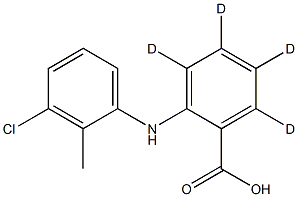
Description
Tolfenamic acid-d
4 is intended for use as an internal standard for the quantification of tolfenamic acid by GC- or LC-MS. Tolfenamic acid is a non-steroidal anti-inflammatory drug (NSAID) with anticancer activity. It is selective for COX-2 over COX-1 in canine DH82 monocyte/macrophage cells (IC
50s = 3.53 and >51.2 μg/ml, respectively). Tolfenamic acid inhibits calcium influx in human polymorphonuclear leukocytes (PMNLs) induced by N-formyl-L-methionyl-L-leucyl-L-phenylalanine (fMLP; ) or the calcium ionophore A23187 (Item Nos.
11016 |
22030) in a concentration-dependent manner. It decreases protein levels of the transcription factors Sp1, Sp3, and Sp4 in PANC-1 and L3.6pl cells when used at a concentration of 50 μM and inhibits proliferation of PANC-1, L3.6pl, and PANC-28 cells in a concentration-dependent manner. Tolfenamic acid (50 and 100 μM) decreases the viability of and induces apoptosis in MDA-MB-231 cells. It reduces tumor growth in an MDA-MB-231 mouse xenograft model when administered at doses of 25 and 50 mg/kg. Tolfenamic acid (150 μmol/kg) reduces carrageenan-induced paw edema in mice by 24%.
Uses
Labelled Tolfenamic Acid. Non-steroidal anti-inflammatory drugs (NSAIDs). A derivative of anthranilic acid, related structurally to Mefenamic and Flufenamic acids. Anti-inflammatory, analgesic.
References
[1] P KAY-MUGFORD. In vitro effects of nonsteroidal anti-inflammatory drugs on cyclooxygenase activity in dogs.[J]. American journal of veterinary research, 2000, 61 7: 802-810. DOI:
10.2460/ajvr.2000.61.802[2] H KANKAANRANTA E M. Flufenamic and tolfenamic acids inhibit calcium influx in human polymorphonuclear leukocytes.[J]. Molecular Pharmacology, 1995, 47 5: 1006-1013.
[3] D. GALANAKIS. Synthesis and Pharmacological Evaluation of Amide Conjugates of NSAIDs with L‐Cysteine Ethyl Ester, Combining Potent Antiinflammatory and Antioxidant Properties with Significantly Reduced Gastrointestinal Toxicity.[J]. ChemInform, 2004, 16 1 1. DOI:
10.1002/chin.200447168[4] MAEN ABDELRAHIM. Tolfenamic acid and pancreatic cancer growth, angiogenesis, and Sp protein degradation.[J]. JNCI Journal of the National Cancer Institute, 2006, 98 12: 855-868. DOI:
10.1093/jnci/djj232[5] HYEONG-JIN KIM. Apoptotic effect of tolfenamic acid on MDA-MB-231 breast cancer cells and xenograft tumors.[J]. Journal of Clinical Biochemistry and Nutrition, 2013, 53 1: 21-26. DOI:
10.3164/jcbn.12-78