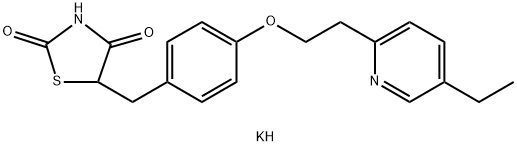
Uses
Pioglitazone (U 72107) potassium is an orally active and selective PPARγ (peroxisome proliferator-activated receptor) agonist with high affinity binding to the PPARγ ligand-binding domain with EC50 of 0.93 μM and 0.99 μM for human and mouse PPARγ, respectively. Pioglitazone potassium can be used in diabetes research[2][3][4].
in vivo
Pioglitazone potassium (oral gavage, 10 or 30 mg/kg, once daily, 14 days) can induce improvements in insulin resistance and diabetes that may be lipocalin-dependent in the liver but not in skeletal muscle[3].
Pioglitazone potassium (oral gavage, 10 mg/kg, once daily, 4 weeks) can significantly reduce body weight (BW), cardiac hypertrophy, elevated blood glucose levels and improve the associated dyslipidemia[4].
| Animal Model: | ob/ob and adipo-/- ob/ob mice with a C57Bl/6 background[3] |
| Dosage: | 10 or 30 mg/kg |
| Administration: | Oral gavage; once daily; 14 days |
| Result: | Showed no changes of serum-free fatty acid and triglyceride levels as well as adipocyte sizes in ob/ob and adipo-/- ob/ob C57BL/6 mice at 10 mg/kg but significantly reduced to a similar degree at 30 mg/kg.
Also showed no changes of expressions of TNFα and resistin in adipose tissues of ob/ob and adipo-/- ob/ob mice at 10 mg/kg but decreased at 30 mg/kg.
|
| Animal Model: | Male Wistar albino rats[4] |
| Dosage: | 10 mg/kg |
| Administration: | Oral gavage; once daily; 4 weeks |
| Result: | Decreased the elevated serum levels of both creatinine and creatine kinase-MB (CK-MB), TGF-β1 gene expression and regulated the expression of MMP-2/TIMP-2 system. |
References
[1] Kenji Kuwabara, et al. A novel selective peroxisome proliferator-activated receptor alpha agonist,2-methyl-c-5-[4-[5-methyl-2-(4-methylphenyl)-4-oxazolyl]butyl]-1,3-dioxane-r-2-carboxylic acid (NS-220), potently decreases plasma triglyceride and glucose levels and modifies lipoprotein profiles in KK-Ay mice. J Pharmacol Exp Ther. 2004 Jun;309(3):970-7. DOI:
10.1124/jpet.103.064659[2] A Puddu, et al. Pioglitazone attenuates the detrimental effects of advanced glycation end-products in the pancreatic beta cell line HIT-T15. Regul Pept. 2012 Aug 20;177(1-3):79-84. DOI:
10.1016/j.regpep.2012.05.089[3] Naoto Kubota, et al. Pioglitazone ameliorates insulin resistance and diabetes by both adiponectin-dependent and -independent pathways. J Biol Chem. 2006 Mar 31;281(13):8748-55. DOI:
10.1074/jbc.M505649200[4] Rania A Elrashidy, et al. Pioglitazone attenuates cardiac fibrosis and hypertrophy in a rat model of diabetic nephropathy. J Cardiovasc Pharmacol Ther. 2012 Sep;17(3):324-33. DOI:
10.1177/1074248411431581