Uses
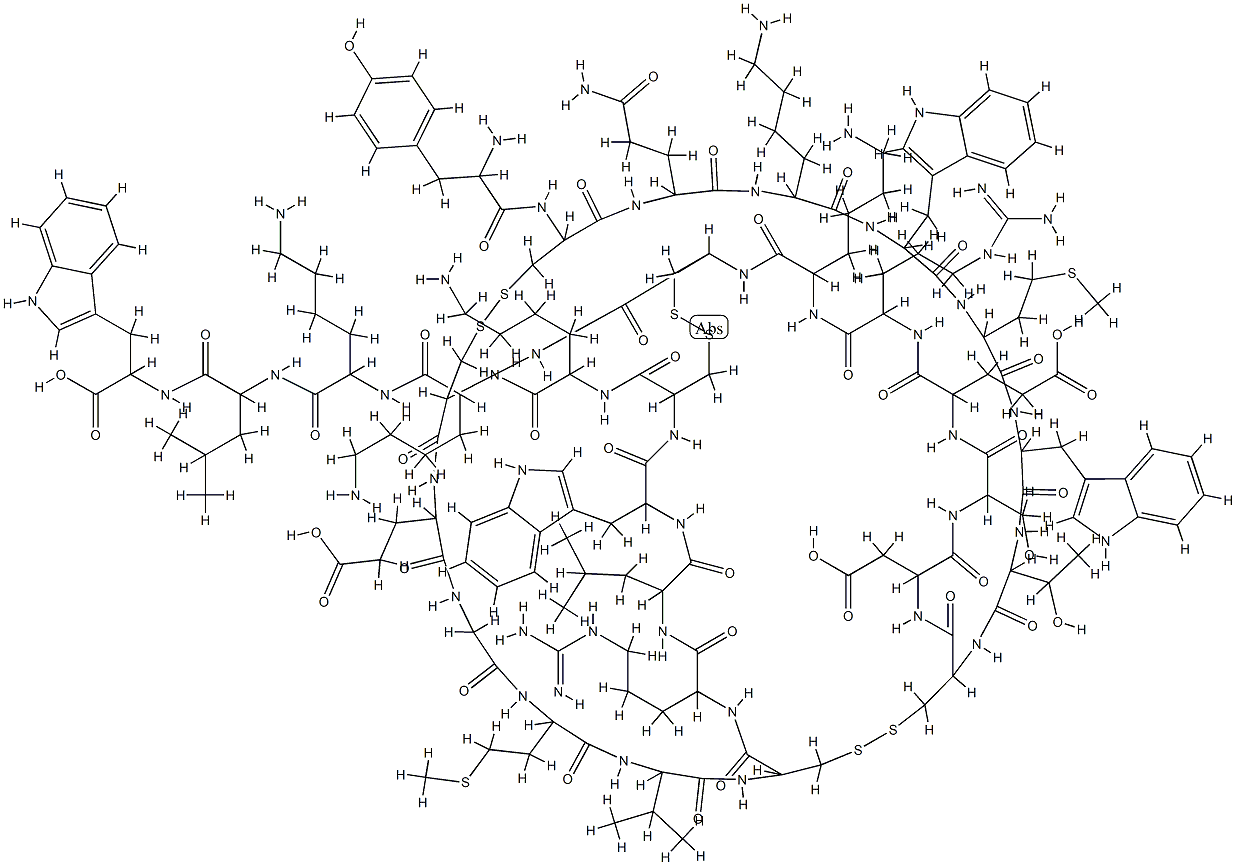
ProTx-II is a potent, selective Nav1.7 blocker. Voltage-gated sodium channels (Nav) are responsible for transducing extracellular signals into action potentials in excitable cells. The Nav1 family consists of nine sub-types for which selective tools are highly valued. Discovery of subtype-selective tools has been challenging due to conservation of putative binding sites. Nav1.7 is expressed in sensory neurons and is critical for pain processing. ProTx-II, isolated from the tarantula Thrixopelma pruriens, is a potent blocker of Nav1 channels. Although ProTx-II blocks several members of this channel family, it has >100-fold selectivity for Nav1.7. ProTx-II is active in an in vitro model of pain processing. ProTx-II binds to a previously unknown site on the channel, conferring selectivity and increasing its value as a research tool. It blocks Nav1.7 by decreasing conductance and shifting the activation potential in the positive direction, resulting in an overall decrease in excitability.
Uses
ProTx II is a selective blocker of Nav1.7 sodium channels with an IC50 of 0.3 nM, and is at least 100-fold selective for Nav1.7 over other sodium channel subtypes. ProTx-II inhibits sodium channels by decreasing channel conductance and shifting activation to more positive potentials and blocks action potential propagation in nociceptors[1][2].
References
[1] Tanaka K, et al. Antihyperalgesic effects of ProTx-II, a Nav1.7 antagonist, and A803467, a Nav1.8 antagonist, in diabetic mice. J Exp Pharmacol. 2015 Jun 24;7:11-6. DOI:
10.2147/JEP.S79973[2] Schmalhofer WA, et al. ProTx-II, a selective inhibitor of NaV1.7 sodium channels, blocks action potential propagation in nociceptors. Mol Pharmacol. 2008 Nov;74(5):1476-84. DOI:
10.1124/mol.108.047670