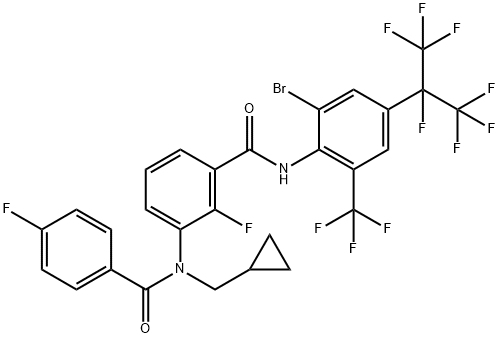
Description
Cyclopranil is a novel insecticide. Currently no data is available on its environmental fate, ecotoxicology or its impact on human health.
Uses
Cyproflanilide is an insecticide. Cyproflanilide is a GABAR antagonist. Cyproflanilide shows high activity against a variety of pests, including lepidopteran, coleopteran, and thysanopteran pests[1].
Production Methods
Cyproflanilide is produced by first constructing the substituted aniline core, then introduce the halogenated and heterocyclic features that define the molecule’s mode of action, and finally bring these fragments together in a controlled coupling step before refining the material to technical grade. Upstream work typically involves preparing the fluorinated aromatic component, assembling the complementary heterocyclic or acyl fragment, and managing reaction conditions to suppress unwanted isomers or over-substitution. These intermediates are then joined through an amide forming reaction, after which the crude cyproflanilide is purified through solvent washes, phase separations, and crystallisation to remove by products and residual reagents. Final finishing includes drying, milling if needed, and quality checks confirming identity, purity, and stability before the active ingredient moves into formulation
Application
Cyproflanilide is a novel isosamide insecticide that exhibits high activity against a wide range of pests. Studies have shown that it can be used to control the rice pest
Chilo suppressalis. Its half-lethal concentration (LC50) and half-lethal dose (LD50) are 0.026 mg L⁻¹ and 0.122 ng/larva, respectively[1].
Definition
ChEBI: Cyproflanilide is a member of the class of benzamides that is benzene in which the hydrogens at positions 1, 2 and 3 are susbtituted by [2-bromo-4-(1,1,1,2,3,3,3-heptafluoropropan-2-yl)-6-(trifluoromethyl)phenyl]aminocarbonyl, fluoro, and (cyclopropylmethyl)(4-fluorobenzoyl)nitrilo groups, respectively. It is an insecticide developed by CAC Shanghai International Trading Co Ltd., China. It has a role as an agrochemical. It is a member of cyclopropanes, a member of (trifluoromethyl)benzenes, a member of benzamides, a member of monofluorobenzenes, a tertiary carboxamide, a secondary carboxamide, a member of bromobenzenes, an organofluorine insecticide and a dicarboxylic acid diamide.
Mechanism of action
An allosteric modulator of gamma-aminobutyric acid (GABA)-gated chloride ion channels
References
[1] Shu H, etal. The transcriptomic profile of Spodoptera frugiperda differs in response to a novel insecticide, cyproflanilide, compared to chlorantraniliprole and avermectin. BMC Genomics. 2023 Jan 3;24(1):3. DOI:
10.1186/s12864-022-09095-2
References
[1] Ge, Wenchao; Qiao, Songtao; Liu, Chong et al. (2025). Baseline establishment, susceptibility monitoring and risk assessment of cyproflanilide, a novel meta-diamide insecticide, against Chilo suppressalis (Lepidoptera: Crambidae) in China. Journal of Integrative Agriculture. 24. 4342-4354.
https://doi.org/10.1016/j.jia.2025.03.028.
Pesticide Type
Insecticide