Description
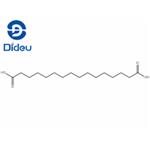
Hexadecanedioic acid (HDDA), also known as thapsic acid, is a straight-chain aliphatic dicarboxylic acid with the molecular formula C₁₆H30O₄. The molecule bears a carboxyl functional group at each end and has a moderate carbon chain length, combining the hydrophobic properties of alkanes with the polymerisation activity of the carboxyl group. It is capable of undergoing condensation polymerisation with diamines and diols, and serves as a key building block for the preparation of long-chain polymers.
Chemical Properties
white powder
Uses
Hexadecanedioic Acid is a useful research intermediate for the studies of blood pressure regulations in humans. Hexadecandedioate works in collaboration with SLCO1B1 as a potential therapy for statin.
Preparation
Hexadecanedioic acid is produced in a single-step oxidation process through microbial fermentation, using n-hexadecane as the substrate and employing high-performing strains such as tropical Candida species.
Definition
ChEBI: Hexadecanedioic acid is an alpha,-dicarboxylic acid that is the 1,14-dicarboxy derivative of tetradecane. It has a role as a human metabolite. It is a dicarboxylic fatty acid and an alpha,omega-dicarboxylic acid. It is a conjugate acid of a hexadecanedioate(2-).
IC 50
Human Endogenous Metabolite
Purification Methods
Crystallise thaspic acid from EtOH, ethyl acetate or *C6H6. [Beilstein 2 IV 2162.]
References
[1] Soskic, Vukic, et al. “Hexadecanedionic Acid−Sepharose 4B: A New Tool for Preparation of Albumin-Depleted Plasma.”
Journal of Proteome Research, 5 12, 2006, pp. 3453–58,
https://doi.org/10.1021/pr060387q.
[2] You, Young-Jae, et al. “Alkyl and Carboxylalkyl Esters of 4′-Demethyl-4-Deoxypodophyllotoxin: Synthesis, Cytotoxic, and Antitumor Activity.”
European Journal of Medicinal Chemistry, 39 2, 2004, p. Pages 189-193,
https://doi.org/10.1016/j.ejmech.2003.10.002.