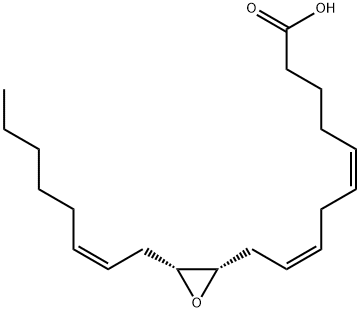
Description
(±)11(12)-EET is a fully racemic version of the R/S enantiomeric forms biosynthesized from arachidonic acid by cytochrome P450 enzymes. A higher proportion of 11(R),12(S)-EET is produced by the CYP450 isoforms CYP2C23 and CYP2C24 while CYP2B2 produces a higher proportion of 11(S),12(R)-EET. 11(12)-EET has been shown, along with 8(9)-EET , to play a role in the recovery of depleted calcium pools in cultured smooth muscle cells. It also inhibits basolateral 18-pS potassium channels in the renal cortical collecting duct when used at a concentration of 100 nM. 11(12)-EET (50 μg/kg per day) increases adhesion of isolated peripheral blood leukocytes in a chamber coated with P-selectin and ICAM-1 but does not affect choroidal neovascularization size following laser photocoagulation. It also has anti-inflammatory, angiogenic, and cardioprotective properties.
Uses
14(15)-Epoxy-5Z,8Z,11Z-eicosatrienoic Acid-D11 is a deuterium labelled 14(15)-Epoxy-5Z,8Z,11Z-eicosatrienoic Acid (E350670), which is a useful research chemical that acts as an endothelium-derived hyperpolarizing factor in bovine coronary arteries to mediate vascular effects of vasoactive hormones.
References
[1] J H CAPDEVILA R C H J R Falck. Cytochrome P450 and arachidonic acid bioactivation. Molecular and functional properties of the arachidonate monooxygenase.[J]. Journal of Lipid Research, 2000, 41 2: 163-181.
[2] B E DAIKH. Regio- and stereoselective epoxidation of arachidonic acid by human cytochromes P450 2C8 and 2C9.[J]. Journal of Pharmacology and Experimental Therapeutics, 1994, 271 3: 1427-1433.
[3] YONGDE ZHANG. EET homologs potently dilate coronary microvessels and activate BK(Ca) channels.[J]. American journal of physiology. Heart and circulatory physiology, 2001, 280 6 1: H2430-40. DOI:
10.1152/ajpheart.2001.280.6.h2430[4] PENG SUN. High potassium intake enhances the inhibitory effect of 11,12-EET on ENaC.[J]. Journal of The American Society of Nephrology, 2010, 21 10: 1667-1677. DOI:
10.1681/asn.2009111110[5] YINDI DING. The biological actions of 11,12-epoxyeicosatrienoic acid in endothelial cells are specific to the R/S-enantiomer and require the G(s) protein.[J]. Journal of Pharmacology and Experimental Therapeutics, 2014, 350 1: 14-21. DOI:
10.1124/jpet.114.214254