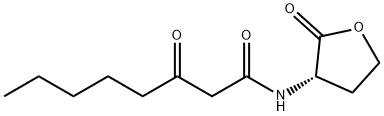
Description
Quorum sensing is a regulatory system used by bacteria for controlling gene expression in response to increasing cell density. This regulatory process manifests itself with a variety of phenotypes including biofilm formation and virulence factor production. Coordinated gene expression is achieved by the production, release, and detection of small diffusible signal molecules called autoinducers. The N-
acylated homoserine lactones (AHLs) comprise one such class of autoinducers, each of which generally consists of a fatty acid coupled with homoserine lactone (HSL). Regulation of bacterial quorum sensing signaling systems to inhibit pathogenesis represents a new approach to antimicrobial therapy in the treatment of infectious diseases. AHLs vary in acyl group length (C
4-
C
18), in the substitution of C3 (hydrogen, hydroxyl, or oxo group), and in the presence or absence of one or more carbon-
carbon double bonds in the fatty acid chain. These differences confer signal specificity through the affinity of transcriptional regulators of the LuxR family. In the gram-
negative bacterium
A. tumefaciens, N-
3-
oxo-
octanoyl-
L-
homoserine lactone promotes the expression of the transcriptional activator (and LuxR homolog) TraR.
Uses
N-3-oxo-octanoyl-L-Homoserine lactone is a reagent that promotes the expression of the transcriptional activator.
Uses
N-(3-Oxooctanoyl)-L-homoserine lactone has been used to study the effects of pH, temperature and salinity on extracellular polymeric substances (EPS) of
Pseudomonas aeruginosa biofilm.
General Description
N-(3-Oxooctanoyl)-L-homoserine lactone is a common quorum sensing (QS) signal.
Biochem/physiol Actions
N-(3-Oxooctanoyl)-L-homoserine lactone stimulates the tra gene expression. It is an autoinducer and potent antagonist.
References
[1] JUAN E GONZáLEZ N D K. Messing with bacterial quorum sensing.[J]. Microbiology and Molecular Biology Reviews, 2006, 70 4: 859-875. DOI:
10.1128/mmbr.00002-06[2] TY A GOULD. Specificity of acyl-homoserine lactone synthases examined by mass spectrometry.[J]. Journal of Bacteriology, 2006, 188 2: 773-783. DOI:
10.1128/jb.188.2.773-783.2006[3] LYNETTE CEGELSKI. The biology and future prospects of antivirulence therapies[J]. Nature Reviews Microbiology, 2008, 6 1: 17-27. DOI:
10.1038/nrmicro1818[4] CARLOS G. NIETO PENALVER . Methylobacterium extorquens AM1 produces a novel type of acyl-homoserine lactone with a double unsaturated side chain under methylotrophic growth conditions[J]. FEBS Letters, 2006, 580 2: Pages 561-567. DOI:
10.1016/j.febslet.2005.12.062[5] J ZHU. Analogs of the autoinducer 3-oxooctanoyl-homoserine lactone strongly inhibit activity of the TraR protein of Agrobacterium tumefaciens.[J]. Journal of Bacteriology, 1998, 180 20: 5398-5405. DOI:
10.1128/jb.180.20.5398-5405.1998