Uses
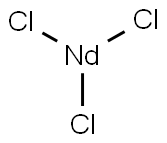
Neodymium Chloride mainly used for glass, crystal and capacitors. Colours glass delicate shades ranging from pure violet through wine-red and warm gray. Light transmitted through such glass shows unusually sharp absorption bands. It is useful in protective lenses for welding goggles. It is also used in CRT displays to enhance contrast between reds and greens. It is highly valued in glass manufacturing for its attractive purple coloring to glass.
Chemical Properties
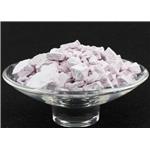
white to off-white powder
Uses
Neodymium(III) chloride is used as a precursor for the production of neodymium metal. It is used as a catalyst and accelerates polymerization of various dienes such as polybutylene, polybutadiene, and polyisoprene. It has luminescence property and is widely used as fluorescent label in organic molecules, thereby helping in easy tracking of the compound using fluorescence microscope during various physical and chemical reactions.
Flammability and Explosibility
Not classified
reaction suitability
reagent type: catalyst
core: neodymium
Safety Profile
Poison by intravenous,
intraperitoneal, and subcutaneous routes.
Moderately toxic by ingestion. A skin and
eye irritant. When heated to decomposition
it emits very toxic fumes of Cl-.
Synthesis
Method for preparing anhydrous neodymium chloride. Steps: (1)-(3) Neodymium carbonate reacts with dilute hydrochloric acid. pH is adjusted. Filtration, impurity removal, and microfiltration give a filtrate. (4)-(7) The filtrate is evaporated, cooled to crystallize, and centrifugally dehydrated to give neodymium chloride crystals. (8)-(11) The crystals are dissolved in pure water, re-concentrated, re-crystallized, and re-dehydrated by centrifugation to give purer crystals. (12) Stepwise isothermal dehydration: The crystals are heated stepwise in an oven at 80C, 110C, 150C, and 200C, holding at each temperature to gradually remove water of crystallization, yielding anhydrous neodymium chloride.