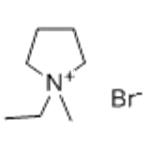
Uses
1-Ethyl-1-methylpyrrolidinium bromide may be used in the preparation of 1-ethyl-1-methylpyrrolidinium lactate, a potential solvent for the separation of hexan-1-ene from hexane. It can also be used to prepare 1-ethyl-1-methylpyrrolidinium tribromide. It can be used as a co-catalyst during the cycloaddition of CO
2 with different epoxides to form cyclic carbonates in the presence of a nona-vacant Keggin-type tricarbonyl rhenium derivative catalyst.
Synthesis
A process for synthesizing quaternary ammonium salt, including the following steps:
S1, replace nitrogen in the whole system in advance, open the metering valves for raw materials and solvent respectively, and add raw material A, raw material B and solvent to the reaction kettle; wherein, raw material A is N-methyl-pyrrolidine; raw material B is ethyl bromide; the solvent is acetone; the quantity of raw material A added is 1 portion, the quantity of raw material B added is 1 portion, and the quantity of solvent added is 5 portions by weight;
S2, start heating, stop heating when the temperature in the reactor reaches the set temperature of 35; control the condenser inlet shut-off valve, and stop heating. The addition amount of raw material A is 1 portion, the addition amount of raw material B is 1 portion, and the addition amount of solvent is 5 portions;
S2, start heating, when the temperature in the reaction kettle reaches the set temperature of 35 , stop heating; control the condenser inlet shut-off valve, so that the pressure in the reaction kettle reaches the set pressure of 30kPa; start the reaction, control the metering valve of the raw material B, regulate the amount of the raw material B added to the control of temperature in the reactor; control the condenser outlet shut-off valve, the raw material B condensation back to the reaction kettle. Cut-off valve, raw material B condensation reflux;
S3, to reach the reaction time of 1h after the end of the reaction, close the condenser inlet cut-off valve, control the reactor pressure of 30kPa, the reaction liquid into the reaction liquid tank, through the steam pressure, the completion of the separation of solid-liquid; solid products directly out of the material, the liquid recycling and utilization. The obtained product yield is 95.47%, raw material conversion rate is 99.5%.