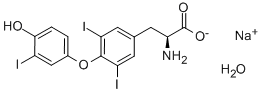
Description
3,3'',5-Triiodo-L-thyronine (T3) is a thyroid hormone. It is produced by 5''-monodeiodination of the prohormone thyroxine (T4) in various tissues, including liver and kidney. T3 is an agonist of thyroid hormone receptors TRα and TRβ (K
is = 2.3 nM for both) that modulates diverse biological properties, including metabolism, cardiac function, growth, and redox signaling. It also functions as an inhibitor of L-type amino acid transporter 1 (LAT1), inhibiting LAT1-mediated leucine uptake in HEK293 cells when used at a concentration of 10 μM.
Uses
Liothyronine sodium hydrate is an active form of thyroid hormone. Liothyronine sodium hydrate is a potent thyroid hormone receptors TRα and TRβ agonist with Kis of 2.33 nM for hTRα and hTRβ, respectively[1][2][3].
IC 50
Human Endogenous Metabolite
References
[1] Lin KH, et al. Stimulation of proliferation by 3,3',5-triiodo-L-thyronine in poorly differentiated human hepatocarcinoma cells overexpressing beta 1 thyroid hormone receptor. Cancer Lett. 1994 Oct 14;85(2):189-94. DOI:
10.1016/0304-3835(94)90274-7[2] Bhat MK, et al. Conformational changes of human beta 1 thyroid hormone receptor induced by binding of 3,3',5-triiodo-L-thyronine. Biochem Biophys Res Commun. 1993 Aug 31;195(1):385-92. DOI:
10.1006/bbrc.1993.2055[3] Hiroaki Shiohara, et al. Discovery of novel indane derivatives as liver-selective thyroid hormone receptor β (TRβ) agonists for the treatment of dyslipidemia. Bioorg Med Chem. 2012 Jun 1;20(11):3622-34. DOI:
10.1016/j.bmc.2012.03.056