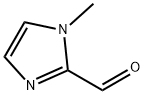
Chemical Properties
White to yellow crystalline mass,
Uses
It is an important raw material and intermediate used in organic synthesis, Pharmaceuticals, agrochemicals and dyestuffs.
Uses
1-Methyl-2-imidazolecarboxaldehyde may be used in the synthesis of:
- Schiff bases
- ligand N,N-dimethyl-N′-(1-methylimidazole-2-ylmethyl)-ethylenediamine
- [(bis(1-methylimidazol-2-yl)methyl)(2-(pyridyl-2-yl)ethyl)amine]
Synthesis Reference(s)
Journal of Medicinal Chemistry, 26, p. 121, 1983
DOI: 10.1021/jm00356a001
General Description
1-Methyl-2-imidazolecarboxaldehyde is a heterocyclic building block. It affords tripodal ligands on condensation reaction with tris-(2-aminoethyl)amine (tren). These tripodal ligands react with iron(III) salts in the presence of air to afford iron(II) complexes. Its vibrational spectral studies have been reported.
Synthesis
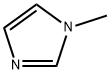
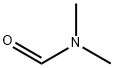
A THF solution of n-butyllithium (nBuLi) was added slowly and dropwise to an anhydrous THF (100 mL) solution of 1-methylimidazole (8.2 g, 100 mmol) cooled to -70 °C. The reaction temperature was maintained at -70 °C and after stirring for 30 min, freshly distilled N,N-dimethylformamide (DMF, 7.3 g, 100 mmol) was added. The reaction mixture was continued to be stirred at 0 °C for 2 h. The reaction was subsequently quenched with ice water. The mixture was extracted with ethyl acetate (EtOAc), the organic phases were combined and dried over anhydrous sodium sulfate (Na2SO4). After evaporation of the solvent under reduced pressure, an oily residue was obtained, which was further purified by distillation under reduced pressure to afford the target product 1-methyl-1H-imidazole-2-carbaldehyde in 68% yield. The structure of the product was confirmed by 1H-NMR (CDCl3): δ 9.76 (s, 1H, CHO), 7.22 (s, 1H, Im-CH), 7.07 (s, 1H, Im-CH), 3.96 (s, 3H, CH3). High-resolution mass spectrometry (EI-HRMS) analysis results: m/z calculated value C5H6N2O 110.0480, measured value 110.0481 (100%), 82.0493 (60%).
References
[1] Inorganica Chimica Acta, 2011, vol. 375, # 1, p. 213 - 219
[2] Dalton Transactions, 2015, vol. 44, # 17, p. 8013 - 8020
[3] Chemistry - A European Journal, 2015, vol. 21, # 36, p. 12735 - 12740
[4] Dalton Transactions, 2011, vol. 40, # 40, p. 10416 - 10433
[5] Tetrahedron, 2000, vol. 56, # 4, p. 645 - 657