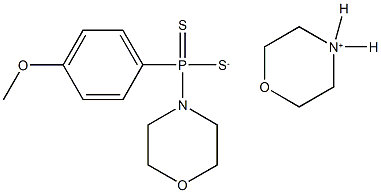
Description
Hydrogen sulfide (H
2S) is a gaseous mediator which, like nitric oxide (NO), has numerous profound actions in mammalian physiology. GYY 4137 is a water-
soluble, slow-
releasing hydrogen sulfide (H
2S) donor. When given intravenously, it demonstrates vasodilator and anti-
hypertensive activity in rats, in either the acute (L-
NAME-
induced) or chronic (spontaneously hypertensive) hypertension models. Intravenous GYY 4137 also protects against endotoxic shock in rats, inhibiting tumor necrosis factor-
α, interleukin (IL)-
1β, and IL-
6 production and reducing NF-
κB activation, iNOS and cyclooxygenase-
2 expression, and NO and prostaglandin E
2 generation.
Uses
GYY 4137 is a slow releasing hydrogen sulfide donor.
Uses
Hydrogen sulfide (H2S) is a gaseous mediator which, like nitric oxide (NO), has numerous profound actions in mammalian physiology. GYY 4137 is a water-soluble, slow-releasing hydrogen sulfide (H2S) donor. When given intravenously, it demonstrates vasodilator and anti-hypertensive activity in rats, in either the acute (L-NAME-induced) or chronic (spontaneously hypertensive) hypertension models. Intravenous GYY 4137 also protects against endotoxic shock in rats, inhibiting tumor necrosis factor-α, interleukin (IL)-1β, and IL-6 production and reducing NF-κB activation, iNOS and cyclooxygenase-2 expression, and NO and prostaglandin E2 generation.[Cayman Chemical]
in vivo
GYY4137 (100-300 mg/kg; i.p.; daily for 14 days) significantly reduces the tumor volume in both animal models, in a dose-dependent manner[2].
In the complete Freund's adjuvant (CFA)-treated mouse, GYY4137 (50 mg/kg, i.p.) injected 1 hr prior to CFA increased knee joint swelling while an anti-inflammatory effect, as demonstrated by reduced synovial fluid myeloperoxidase (MPO) and N-acetyl-β-D-glucosaminidase (NAG) activity and decreased TNF-α, IL-1β, IL-6 and IL-8 concentration, was apparent when GYY4137 was injected 6 hrs after CFA[3].
GYY4137 significantly inhibited tumor growth in the subcutaneous HepG2 xenograft model by inhibiting STAT3 activation and its target gene expression[4].
GYY4137 prevents nitrative stress and α-synuclein nitration in an MPTP mouse model of parkinson’s disease[5].
| Animal Model: | Female, severe combined immunodeficiency (SCID) mice (bearing HL-60 or MV4-11 cells)[2] |
| Dosage: | 100, 200 and 300 mg/kg |
| Administration: | I.p.; daily for 14 days |
| Result: | Reduced tumor volume by 52.5% and 55.3% in HL-60 and MV4–11 injected animals.
|
References
[1] LING LI. Characterization of a novel, water-soluble hydrogen sulfide-releasing molecule (GYY4137): new insights into the biology of hydrogen sulfide.[J]. Circulation, 2008, 117 18: 2351-2360. DOI:
10.1161/circulationaha.107.753467[2] LING LI . GYY4137, a novel hydrogen sulfide-releasing molecule, protects against endotoxic shock in the rat[J]. Free Radical Biology and Medicine, 2009, 47 1: Pages 103-113. DOI:
10.1016/j.freeradbiomed.2009.04.014[3] PETER J ELLIOTT Wolf H B Thomas Matthias Zollner. Proteasome inhibition: a new anti-inflammatory strategy.[J]. Journal of Molecular Medicine-Jmm, 2003, 81 4: 235-245. DOI:
10.1007/s00109-003-0422-2