Synthesis
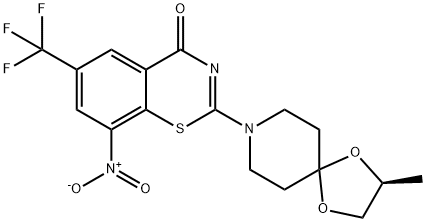
Synthesis of 2-[(2S)-2-methyl-1,4-dioxa-8-azaspiro[4.5]decan-8-yl]-8-nitro-6-(trifluoromethyl)-4H-benzo[e][1,3]thiazin-4-one (Compound 1) and (2S)-2-methyl-1,4-dioxa-8-azaspiro[4.5]decane as 2-(methylsulfanyl)-6-(trifluoromethyl)-4H-benzo[e][1,3]thiazin-4-one (Compound 1) and (2S)-2-methyl-1,4-dioxa-8-azaspiro[4.5]decane. -Trifluoromethyl-4H-1,3-benzothiazin-4-one was carried out in the following general steps: 3.0 g of Compound 1 was suspended in 15 mL of ethanol followed by the addition of 1.5 g of (2S)-2-methyl-1,4-dioxa-8-azaspiro[4.5]decane. The reaction mixture was stirred at room temperature and then heated to 50-60°C maintained for 20 minutes. Upon completion of the reaction, it was cooled to room temperature and a light yellow solid was precipitated by adding 100 mL of water. The product was isolated by filtration in 76% yield (calculated based on 2-chloro-3-nitro-5-trifluoromethylbenzamide).
in vivo
Four weeks of treatment with BTZ043 reduces the bacterial burden in the lungs and spleens by 1 and 2 logs, respectively, at the concentrations used. Additional results suggest that BTZ043 efficacy is time-rather than dose-dependent. Acute (5 g/kg) and chronic (25 and 250 mg/kg) toxicology studies in uninfected mice show that, even at the highest dose tested, there are no adverse anatomical, behavioral, or physiological effects after one month[2].
References
[1] Patent: EP2380886, 2011, A1. Location in patent: Page/Page column 8
[2] Patent: WO2011/132070, 2011, A1. Location in patent: Page/Page column 12-13

![(S)-2-methyl-1,4-dioxa-8-azaspiro[4.5]decane](/CAS/20200401/GIF/1344087-80-4.gif)
![2-(Methylthio)-8-nitro-6-(trifluoromethyl)-4H-benzo[e][1,3]thiazin-4-one](/CAS/20200331/GIF/1344087-73-5.gif)
