Chemical Properties
White Solid
Usage
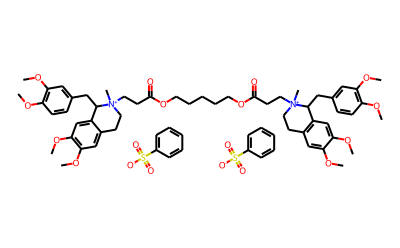
An enantiomer of Atracurium Besylate (A794500). A neuromuscular blocking agent. It could be used in liver transplant patient with safety.
Usage
Cisatracurium Besylate is a nondepolarizing neuromuscular blocking agent, antagonizing the action of acetylcholine by inhibiting neuromuscular transmission.
Description
Cisatracurium besylate is a new intermediate-duration non-depolarizing muscle
relaxant launched in the U.S.A. for intubation and maintenance of muscle
relaxation during surgery and intensive care. Cisatracurium besylate is the single 1 R cis-1'R cis isomer of the commercial preparation of atracurium, a mixture of 10 isomers.
It is 3 to 5 times more potent than the mixture with similar onset and duration of action. The single isomer was also reported to have reduced propensity to release histamine
and have a stable cardiovascular profile. Similar to structurally related mivacurium,
cisatracurium has distinct advantages of rapid degradation, enzymatic metabolism that is independent of liver or kidney resulting in short duration of action and fast, complete recovery.
Originator
Glaxo Wellcome (United Kingdom)
Uses
An enantiomer of Atracurium Besylate (A794500). A neuromuscular blocking agent. It could be used in liver transplant patient with safety.
Uses
Cisatracurium Besylate is a nondepolarizing neuromuscular blocking agent, antagonizing the action of acetylcholine by inhibiting neuromuscular transmission.
Definition
ChEBI: The (1R,1'R,2R,2'R)-diastereoisomer of atracurium besylate. Commercial preparations of atracurium are mixtures of 10 stereoisomers, of which cisatracurium generally constitutes about 15%.
isatracurium besylate is about 3 times more potent than the mixture of atracurium isomers as a neuromuscular blocking agent, and is used as a muscle relaxant for endotracheal intubation, to aid controlled ventilation, and in general anaesthesia.
Manufacturing Process
Acryloyl chloride (0.2 mole) in dry benzene (60 ml) was added over 0.5 hour
to pentane-1,5-diol (0.1 mole), triehylamine (0.2 mole) and pyrogallol (0.1 g)
in dry benzene (100 ml). Further dry benzene (100 ml) was added followed by
triehylamine (10 ml), and the mixture stirred at 50°C for 0.5 hour. The
triehylamine hydrochloride was filtered off and the solvent removed in vacuo
to leave yellow oil which was distilled in the presence of a trace of p�methoxyphenol, excluding light, to give 1,5-pentamethylene diacrylate (12.9
g, 61%, b.p. 90-95°C/0.01 mm Hg).
A solution of tetrahydropapaverine (4.43 g) and 1,5-pentamethylene
diacrylate (1.30 g) in dry benzene (15 ml) was stirred under reflux for 48
hours, excluding light. The solvent was removed in vacuo and the residual
pale red oil dissolved in chloroform (10 ml). Addition of ether (ca. 400 ml),
followed by saturated ethereal oxalic acid solution (ca. 500 ml) gave a
flocculent white precipitate, which was filtered off, washed with ether and
dried. Crystallization (twice) from ethanol gave N,N'-4,10-dioxa-3,11-
dioxodecylene-1,13-bis-tetrahydropapaverine dioxalate as a white powder (3.5
g, 51%, m.p. 117-121°C).
The free base N,N'-4,10-dioxa-3,11-dioxodecylene-1,13-bis�tetrahydropapaverine was obtained by basifying an aqueous solution of the
dioxalate with sodium bicarbonate solution, followed by extraction with
toluene and evaporation of the solvent, to give a colorless viscous oil.
Scrupulously dried base in spectroscopically pure acetonitrile was treated with
benzenesulfonic acid at room temperature for 22 hours. The filtered reaction
mixture was added dropwise to dry ether (ca. 450 ml). The flocculent white
precipitate was filtered off, washed with dry ether, and dried in vacuo over
P2O5 at 50°C to yield N,N'-4,10-dioxa-3,11-dioxodecylene-1,13-bis�tetrahydropapaverine dimesylate, a white powder with m.p. 104-112°C.
Brand name
Nimbex (Abbott).
Therapeutic Function
Neuromuscular blocker