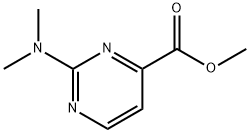
1. 2-Dimethylamino-4-trifluoromethylpyrimidine (320 mg, 1.7 mmol) and sodium hydroxide (670 mg, 17 mmol) were suspended in a solvent mixture of methanol (5.0 mL) and water (5.0 mL). 2. The reaction mixture was stirred in a sealed tube using microwave radiation for 2.5 h at 160 °C. 3. After completion of the reaction, the reaction mixture was diluted with ethyl acetate (30 mL) and extracted sequentially with water (30 mL) and saturated aqueous sodium bicarbonate (30 mL). 4. The pH of the water layer was adjusted with 6 M hydrochloric acid. After completion of the reaction, the reaction mixture was diluted with ethyl acetate (30 mL) and sequentially extracted with water (30 mL) and saturated aqueous sodium bicarbonate (30 mL) each. 4. The pH of the aqueous layer was adjusted to 7 with 6 M hydrochloric acid, followed by concentration under reduced pressure. 5. The concentrated residue was suspended in N,N-dimethylformamide (5.0 mL), sodium bicarbonate (1.3 g, 14 mmol) and methyl iodide (0.87 mL, 17 mmol) were added. 17 mmol) and iodomethane (0.87 mL) and stirred at room temperature for 23 h. 6. The reaction mixture was diluted with ethyl acetate (100 mL), washed twice with saturated aqueous sodium bicarbonate (100 mL) and twice with brine (100 mL), and then dried with anhydrous magnesium sulfate. 7. The solvent was evaporated under reduced pressure, and the residue was purified by silica gel column chromatography to afford methyl 2-(dimethylamino)pyrimidine-4-carboxylate (28 mg, yield 9.0 mg). 8. (28 mg, yield 9.3%) as colorless needle-like crystals.1H-NMR (500 MHz, CDCl3) δ 3.24 (s, 6H), 3.95 (d, J = 0.6 Hz, 3H), 7.07 (d, J = 4.8 Hz, 1H), 8.49 (dd, J = 4.8, 0.6 Hz, 1H).