| Appearance |
Lyophilized |
| density |
1.00 g/mL at 20 °C
|
| storage temp. |
2-8°C
|
| solubility |
50 mM Tris pH 8.0: 10 mg/mL, clear, faintly brown-yellow
|
| form |
buffered aqueous solution
|
| color |
White to Light yellow to Light orange |
| biological source |
human placenta |
| Water Solubility |
Dissolve in TE buffer or water at 2mg/ml |
| Cosmetics Ingredients Functions |
SKIN CONDITIONING |
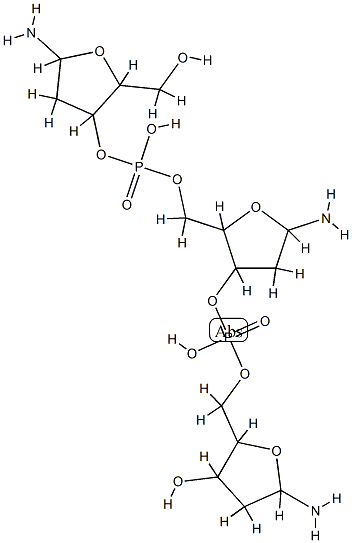
| InChI |
1S/C15H31N3O13P2/c16-13-1-7(20)11(28-13)5-25-32(21,22)31-9-3-15(18)29-12(9)6-26-33(23,24)30-8-2-14(17)27-10(8)4-19/h7-15,19-20H,1-6,16-18H2,(H,21,22)(H,23,24) |
| InChIKey |
AWBASQCACWFTGD-UHFFFAOYSA-N |
| SMILES |
[P](=O)(OC2C(OC(C2)N)CO[P](=O)(OC3C(OC(C3)N)CO)O)(OCC1OC(CC1O)N)O |
| Uses |
DNA (freeze-dried)(pure biological)(pure vegetal)(deoxyribonucleic acid) is a surface film-forming protein with moisturizing action. DnA’s large macromolecules do not enable it to penetrate the skin. In addition, its affinity with the stratum corneum layer keeps it anchored to the skin’s surface, where it serves to protect and retain skin moisture. Although the use of DnA was particularly popular in the 1980s, its incorporation into cosmetic products since then has practically disappeared. It is usually used in a potassium salt form obtained from fish sperm.
|