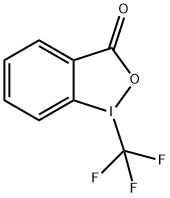
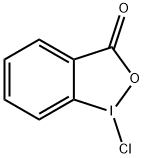
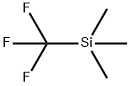
General procedure for the synthesis of 1-(trifluoromethyl)-1,2-phenyliodonyl-3(1H)-ones from 1-chloro-1,2-phenyliodonyl-3-one and (trifluoromethyl)trimethylsilane: Potassium acetate (10.8 g, 0.110 mol, 2.00 eq.) was dried under vacuum at 150 °C for 30 min and subsequently cooled to room temperature. To this was added 1-chloro-1,2-phenyliodono-3-one (15.6 g, 0.0551 mol, 1.00 eq.) and acetonitrile (155 mL), and the reaction mixture was stirred at 75 °C for 2 hours. After completion of the reaction, the mixture was cooled to room temperature. (Trifluoromethyl)trimethylsilane (8.97 mL, 0.0607 mol, 1.10 eq.) was added all at once and the reaction mixture was stirred at room temperature for 15 hours. Subsequently, acetonitrile (100 mL) was added and the brown reaction mixture was heated to 75 °C. The reaction mixture was filtered through a diatomaceous earth pad, concentrated to a final volume of about 50 mL and cooled to -20 °C. The crystals were filtered out, washed with cold (-20 °C) acetonitrile (50 mL) and dried under vacuum. The mother liquor was reconcentrated to a final volume of about 15 mL and cooled to -20 °C. The crystals were filtered out and washed with cold (-20°C) acetonitrile (10 mL). Both crystallization products were dried under high vacuum to afford 1-(trifluoromethyl)-1,2-phenyliodonyl-3(1H)-one as a white crystalline solid (14.6 g, 0.0463 mol, 84% yield). The NMR data were as follows: 1H NMR (500 MHz, CDCl3, 25 °C, δ): 8.48 (dd, J = 7.2, 1.7 Hz, 1H), 7.85-7.76 (m, 3H). 13C NMR (175 MHz, CDCl3, 25 °C, δ): 165.9, 135.9, 133.9, 132.1, 132.0 , 127.3 (q, J = 2.5 Hz), 114.9, 107.3 (q, J = 378.8 Hz).19F NMR (376 MHz, CDCl3, 25 °C, δ): -34.2 (s). These spectral data are in agreement with literature reports.