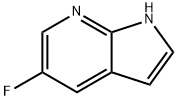
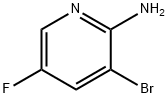
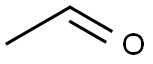
General procedure for the synthesis of 5-fluoro-1H-pyrrolo[2,3-b]pyridine from 2-amino-3-bromo-5-fluoropyridine and acetaldehyde: To a nitrogen-purged 500 mL pressure reactor were added sequentially 3-bromo-5-fluoropyridin-2-ylamine (compound 2a) (20 g, 104.7 mmol, 1.0 equiv.), DABCO (17.6 g, 157.0 mmol, 1.5 equiv.) and tetrabutylammonium bromide (3.38 g, 10.5 mmol, 0.1 equiv.). mmol, 1.5 eq.) and tetrabutylammonium bromide (3.38 g, 10.5 mmol, 0.1 eq.). Subsequently, anhydrous dimethyl sulfoxide (40 mL) and anhydrous ethyl acetate (120 mL) were added to the reactor and the resulting mixture was degassed by nitrogen bubbling for 30 minutes. Next, bis(dibenzylideneacetone)palladium(0) (3.01 g, 5.24 mmol, 0.05 eq.), 10% w/w hexane solution of tri-tert-butylphosphine (21.2 g, 10.47 mmol, 0.1 eq.), and acetaldehyde (5.08 g, 115.2 mmol, 1.1 eq.) were added, and the reaction vessel was sealed. The reaction mixture was stirred at room temperature for 1 hour and then transferred to a 76.5°C oil bath for 5 hours. Upon completion of the reaction, the reaction system was cooled and sampled for HPLC analysis. Upon confirmation of complete conversion of compound 2a to target product 3b (typically 100% conversion after 5 h), the reaction was quenched by adding water (40 mL) to the reaction mixture. The aqueous phase was back-extracted with ethyl acetate (40 mL), and the organic phases were combined and filtered through a diatomaceous earth pad to remove fine solids. The diatomaceous earth pad was washed with ethyl acetate (40 mL), 5% Na2CO3 solution (60 mL) was added to the combined organic phases and stirred under nitrogen protection for 30 minutes. The organic phase was separated, washed with water (60 mL) and concentrated at 80 °C under reduced pressure.

![5-FLUORO-1H-PYRROLO[2,3-B]PYRIDINE](/CAS/GIF/866319-00-8.gif)