Description
Chloretazate is an obsolete plant growth regulator for turf. Little data is available regarding its environmental fate, ecotoxicology or impacts on human health.
Uses
Karetazan is used in the preparation of Pyrazole derivatives as pesticides as well as as a chemical hybridisation agent for commercial hybrid seed production.
Definition
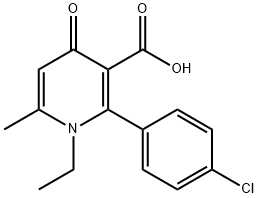
ChEBI: Karetazan is a member of the class of 4-pyridones that is N-ethyl-4-pyridone that is substituted at positions 2, 3, and 6 by p-chlorophenyl, carboxy, and methyl groups, respectively. It is used (particularly as its potassium salt, known as karetazan-potassium) as a chemical hybridisation agent for commercial hybrid seed production. It is not approved for use within the European Union. It has a role as a chemical hybridisation agent. It is a monocarboxylic acid, a member of monochlorobenzenes, a biaryl and a member of 4-pyridones. It is a conjugate acid of a karetazan(1-).
Production Methods
Chloretazate is typically commercially synthesised involving a multi-step organic process starting from substituted pyridine derivatives, incorporating a 4-chlorophenyl group and ethyl substituent through controlled alkylation and acylation processes.
Pesticide Type
Herbicide; Plant Growth Regulator