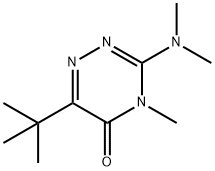
Production Methods
The commercial production of amibuzin follows a multi-step synthesis that begins with the condensation of tert-butylglyoxal or its equivalent (from pinacolone oxidation) with semicarbazide hydrochloride in aqueous ethanol under acidic conditions (pH 4–5) at 50–60 DegC to form the 6-tert-butyl-3-hydrazino-1,2,4-triazin-5(4H)-one hydrazone intermediate. This is followed by N-methylation using dimethyl sulphate or methyl iodide in the presence of sodium hydroxide in methanol at room temperature, yielding the 3-hydrazono-4-methyl derivative. The key step involves selective orthoformylation of the hydrazone with formic acid or ethyl formate under basic conditions at 40–50 DegC to introduce the formyl group, which is then reductively aminated with dimethylamine and sodium cyanoborohydride in methanol at pH 7–8 and 25 DegC to install the 3-(dimethylamino) substituent with >90% regioselectivity. The crude product is isolated by acidification, extracted with dichloromethane, and purified by recrystallisation.