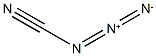
Chemical Properties
clear, colorless, oily liquid; can detonate on thermal, electrical, or mechanical shock; decomposes in acetonitrile solvent; made by suspending NaN3 in dry acetonitrile, followed by distillation of cyanogen chloride into the cooled suspension; used in organic synthesis for example reacts with alkanes to produce primary alkyl cyanamides [MER06]
Uses
In organic synthesis. Has a versatility and scope of chemical reactivity that is very broad and useful, e.g. reacts with alkanes to give primary alkylcyanamides: Anastassiou et al., J. Am. Chem. Soc. 87, 2296 (1965).
Preparation
Preparative Methods of Cyanogen Azide: by the addition of cyanogen chloride or Cyanogen Bromide to an acetonitrile solution
of Sodium Azide in the temperature range of 10-25 °C. The reagent is used in solution after filtration or
decantation of the inorganic salts.
General Description
Cyanogen Azide is a 1,3-dipolar reagent that undergoes cycloaddition and insertion reactions with alkenes[1].
storage
Cyanogen Azide should be used in solution. In acetonitrile a 27% by weight solution of
cyanogen azide has a half-life of 15 days at 25 °C. The pure material is highly explosive and detonates
violently when exposed to mild thermal, mechanical, or electrical shock. This reagent should be handled
in a fume hood.
References
1. 1,3-Dipolar Cycloaddition Chemistry; Lwowski, W., Ed.; Wiley: New York, 1984; Vol. 1, p 817.