Description
Fenpiclonil is the
first phenylpyrrole fungicide developed by Ciba Geigy
(now belonging to the portfolio of Syngenta Crop Protection
AG) for seed treatment. Different formulation
types have been used for its commercialization either
in solo (trade name “Beret”) or in mixture with other
fungicides, as for instance, imazalil (“Beret Special”) or
carboxin + imazalil (“Beret Universal”).
Chemical Properties
The pure product is white crystals. Its mp is 152.9°C and its vapor pressure is 420×10-9 Pa (20°C). Its solubility in water at 20°C is 2 mg/L, and its partition coefficient (n-octanol/water) is 20,000. It is stable below 250°C. At a pH of 3-9 and 100°C, it is stable for 6 hours. Its half-life in soil is 150-250 days.
Uses
Agricultural fungicide.
Uses
Fenpiclonil is a systemic and contact fungicide that provides protective
control of seed-borne pathogens of cereals such as snow mould
and bunt caused by Fusarium spp., Tilletia caries, Septoria nodorum, etc. It
also controls leaf spot, brown foot rot and ear blight in non-cereal crops.
Definition
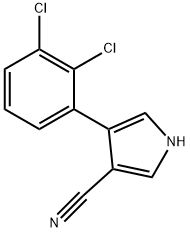
ChEBI: A member of the class of pyrroles carrying cyano and 2,3-dichlorophenyl substituents at positions 3 and 4 respectively. A fungicide used mainly to control seed-borne pathogens in cereal crops.
Production Methods
Fenpiclonil is commercially produced through a multi-step chemical synthesis that centres on constructing its pyrrole-based structure. The process begins with the preparation of 2,3-dichlorobenzaldehyde, which undergoes condensation with cyanoacetic acid derivatives to form the key intermediate. This intermediate is then cyclised to yield 4-cyano-3-(2,3-dichlorophenyl)pyrrole, the active ingredient in fenpiclonil. The reaction typically takes place in organic solvents under controlled temperature and pH conditions to ensure high yield and purity.
General Description
Fenpiclonil is a phenylpyrrole fungicide and a structural analogue of the antibiotic pyrrolnitrin found to be toxic to representatives of Ascomycetes, Basidiomycetes, and Deuteromycetes.
Mechanism of action
Broad-spectrum, long-lasting activity, inhibits glucose phosphorylation. Osmotic signal transduction.
Metabolic pathway
Limited data are available in the open literature. Information presented in
this summary was abstracted from the data evaluation published by the
Pesticide Safety Directorate (PSD, 1993). Fenpiclonil is stable to hydrolytic
and soil degradation. Photolytic degradation is rapid. Hydroxylation
and oxidation of the pyrrole ring are the primary metabolic reactions in
plants and animals (Scheme 1).
Degradation
Fenpiclonil (1) is stable to hydrolytic degradation (up to 70 °C) over the
pH range 5-9.
Fenpiclonil degraded rapidly in water (pH 7) when samples were
irradiated under a mercury arc lamp (>290 nm) with an estimated DT50
values of <1 hour. At least eight unidentified degradation products were
observed