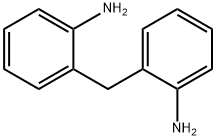
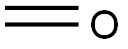
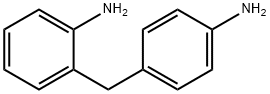
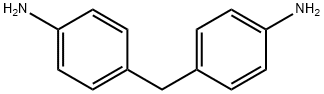
The general procedure for the synthesis of 2-(4-aminobenzyl)aniline, 2,2'-methylenedianiline and 4,4'-diaminodiphenylmethane from formaldehyde and aniline hydrochloride is as follows:
1. hydrochloric acid from tank 2 (at a concentration of 30.8 wt%, which is a by-product of the MDI unit) and aniline from tank 3 are transported via pump 6 in a ratio of hydrochloric acid to aniline at a molar ratio of 0.36:1 to a venturi mixer 5, wherein mixing is carried out and reaction is carried out to generate aniline hydrochloride. Subsequently, the generated aniline hydrochloride is pumped into a recirculation tube and mixed with the recirculating solution from the condensing mixing vessel 1 to form a mixed solution.
2. The mixed solution is introduced into a heat exchanger 7, where the heat of reaction is removed, cooled to 38°C, and then conveyed to the inlet of a high gravity rotary bed reactor 8.
3. at the same time, the formaldehyde solution (with a concentration of 37 wt%) from the storage tank 4 was fed through the other feed port of the high gravity rotary bed reactor 8, controlling the molar ratio of formaldehyde to aniline to be 0.40:1. in the high gravity rotary bed reactor 8, the formaldehyde solution was fully mixed with the premixed solution and underwent a pre-condensation reaction under the following reaction conditions: temperature 35°C, reaction time 0.5 sec, rotor speed 1000 rpm.
4. The mixed solution after reaction flows into the condensation reactor 1 for further pre-condensation reaction under the following conditions: temperature 42°C, stirring speed 110 rpm, reaction residence time 20 minutes.
5. Subsequently, the temperature of the reaction solution was raised to above 90 °C for a molecular rearrangement reaction with a reaction residence time of about 2 h. A solution of diphenylmethylene diamine hydrochloride and polymethylene polyphenylene polyamine hydrochloride was finally obtained.
6. Of the reaction mixture from the condensing reactor 1, 92 vol% was returned to the recirculation tubes as a recirculating solution and flowed through the heat exchanger 7, while the remaining 8 vol% was discharged and neutralized with a sodium hydroxide solution at a concentration of 42 wt%.
7. The brine phase was separated from the polyamine organic phase, the polyamine organic phase was washed with water and purified to give a final mixture of diphenylmethylene diamine and polymethylene polyphenylene polyamine. The product composition is detailed in Table 2.