Uses
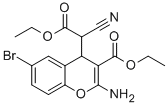
Cell permeable, low molecular weight Bcl-2 ligand. Antagonizes the function of Bcl-2 and induces apoptosis. In HL-60 cells, HA4-1 (50μM and 4h incubation) induced apoptosis of more than 90% of the cells. Apoptosis is blocked by ZVAD-FM. IC50 = ~9μM for competition with Flu-BakBH3 binding to Bcl-2.
Synthesis
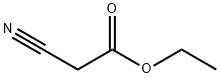
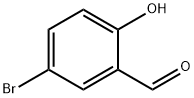
GENERAL METHODS: 1,1,3,3-Tetramethylguanidine (TMG, 3.5 mmol) was added to a mixture of 5-bromosalicylaldehyde (SA, 1 mmol), ethyl cyanoacetate (MN, 1 mmol), and 2,3-diaminopyridine (DAP, 1 mmol) under pure conditions. The reaction mixture was stirred at room temperature and the reaction process was monitored by thin layer chromatography (TLC). Upon completion of the reaction, distilled water (15 mL) was added to the reaction mixture and stirring was continued until a free-flowing solid was formed. The solid was collected by filtration and washed sequentially with water and hexane. The crude product was purified by recrystallization from ethanol solution: the crude product was dissolved in boiling ethanol to saturation and hot filtered to remove undissolved solid. The hot filtrate was cooled to room temperature to give an elementally analytically pure crystalline product, rel-(αR,4R)-2-amino-6-bromo-4-(1-cyano-2-ethoxy-2-carbonyl)-4H-benzofuran-3-carboxylic acid. Similar experimental procedures were used to synthesize all 2-amino-4H-benzofuran derivatives.
References
[1] Tetrahedron Letters, 2005, vol. 46, # 20, p. 3497 - 3499
[2] RSC Advances, 2015, vol. 5, # 80, p. 65526 - 65531
[3] Tetrahedron, 2013, vol. 69, # 49, p. 10544 - 10551
[4] Tetrahedron Letters, 2006, vol. 47, # 43, p. 7629 - 7633
[5] Russian Chemical Bulletin, 2008, vol. 57, # 3, p. 595 - 600