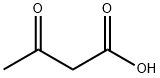
Chemical Properties
Acetoacetic acid, also known as 3-oxobutanoic acid, is a colourless, oily liquid or crystalline substance. It is strongly acidic and unstable. When heated to 100°C, it decomposes vigorously into acetone and carbon dioxide. It is miscible with water and alcohols and has a melting point of 36–37°C. Acetoacetic acid is a ketone body found in abnormal quantities in the blood and urine under certain conditions, such as diabetes.
Uses
In organic syntheses.
Definition
ChEBI: A 3-oxo monocarboxylic acid that is butyric acid bearing a 3-oxo substituent.
Reactivity Profile
Acetone enolate equivalent in alkylations, carbonyl additions, conjugate additions, and diazonium ion coupling reactions[4-7].
Health effects
Acetoacetic acid and β-hydroxybutyric acid are both acidic substances that can lead to metabolic acidosis, which may cause damage to the cardiovascular and cerebrovascular systems, impair oxygen utilization, and result in respiratory paralysis. In severe cases, complications such as cerebral edema, respiratory failure, and heart failure may occur, potentially leading to death.
Synthesis
Traditionally prepared by base hydrolysis of Ethyl Acetoacetate. A high yield synthesis by acid hydrolysis of Diketene is also reported[1-3].
storage
Handling, Storage, and Precautions: acetoacetic acid is extremely hygroscopic but can be stored under vacuum in a freezer for several weeks with little change. It decomposes rapidly to acetone and carbon dioxide when heated above the melting point. Use in a fume hood.
References
1. Grayson, D. H.; Tuite, M. R. J. JCS(P1) 1986, 2137
2. Grande, K. D.; Rosenfeld, S. M. JOC 1980, 45, 1626.
3. Krueger, R. C. JACS 1952, 74, 5536.
4. Kjonaas, R. A.; Patel, D. D. TL 1984, 25, 5467.
5. Grayson, D. H.; Tuite, M. R. J. JCS(P1) 1986, 2137.
6. Fujii, M.; Terao, Y.; Sekiya, M. CPB 1974, 22, 2675.
7. (a) Parmerter, S. M. OR 1959, 10, 1. (b) Phillips, R. R. OR 1959, 10, 143.