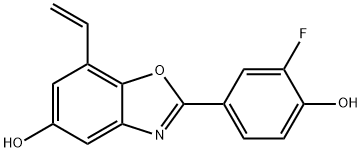
Example 1; Preparation of 2-(3-fluoro-4-hydroxyphenyl)-7-vinylbenzo[d]oxazol-5-ol
To a 2-gallon hydrogenator was added 7-bromo-2-(3-fluoro-4-hydroxyphenyl)benzo[d]oxazol-5-ol (300 g, 0.926 mol), tri-o-tolylphosphine (9.1 g, 3.3%), palladium diacetate (2.1 g, 1%), acetonitrile (4.5 liters), and triethylamine (375 g, 4 equiv). The hydrogenator was flushed with nitrogen and ethylene; the pressure was then adjusted to 50 psi. the reaction mixture was heated to 75 °C and held for 16 h, at which point HPLC analysis showed 0.2% of the feedstock remaining. The mixture was cooled to 35-40 °C and filtered through a 0.2 μm filter column and washed with 1,2-diethoxyethane (1.2 L). The filtrate was concentrated to 1.2 L under reduced pressure and water (1.5 L) and 1,2-diethoxyethane (1.2 L) were added. The pH was adjusted to 11-12 by slowly adding 1.4 L of 2N NaOH solution at 15-20 °C. The phases were separated and the organic phase was extracted with water (300 mL) and 2N NaOH (20 mL). The combined aqueous phases were washed with 1,2-diethoxyethane (2 x 900 mL). The pH was adjusted to 2.5-3.5 by adding 500 mL of 4N HCl at 15-20 °C. After holding for 4 h, the solid was filtered out and washed with water (3 × 200 mL). The wet filter cake was suspended in acetone (1822mL) and heated to 54-60°C until completely dissolved. Acetonitrile (1822mL) was added dropwise over 0.5 hours while maintaining 54-60°C. The solution was concentrated to 1.8-2.0 L by distillation at atmospheric pressure, then the concentrate was cooled to 45-50 °C and held for 0.5 h; it was then cooled to -3 to 3 °C and held for 1 h. The solution was concentrated to 1.8-2.0 L by distillation at atmospheric pressure. The solid was filtered out and washed with pre-cooled acetonitrile (2 x 200 mL); it was then dried in a vacuum oven at 55-65 °C and 5-10 mmHg for 24 h to give 180 g (71.5% yield) of the target product. The above product was dissolved in ethyl acetate (23 v/v) at 75-80 °C. The resulting solution was cooled to 25-45 °C and treated with activated carbon. The filtrate was concentrated to 7 volumes at atmospheric pressure and heptane (6 volumes) was added to the slurry while maintaining the temperature at 75-80 °C. The solution was then cooled to 45-50 °C and held for 0.5 h. It was subsequently cooled to 0-5 °C and held for 1 h. The slurry was then treated with activated carbon. The solid was filtered out and dried at 55-65°C and 5-10 mmHg to give 87% recovery and 99.4% purity.