Reactions
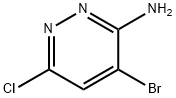
The stability and reactivity of 3-Amino-4-bromo-6-chloropyridazine can be influenced by the electronic effects of the halogen substituents and the amino group, making it a subject of study in synthetic organic chemistry.
Synthesis
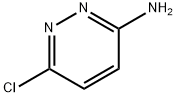
Example I (1) Bromine (9.71 g, 3.15 mL, 60.75 mmol) was slowly added dropwise to a mixed solution containing 3-amino-6-chloropyridazine (7.87 g, 60.75 mmol), methanol (115 mL) and sodium bicarbonate (10.22 g, 121.67 mmol). The reaction mixture was stirred at room temperature for 16 hours and then filtered. Water (500 mL) was added to the filtrate and subsequently extracted with ethyl acetate (3 × 500 mL). The organic layers were combined and concentrated under reduced pressure. The resulting residue was purified by fast chromatography using 1:1 hexane/ethyl acetate as eluent, resulting in 5.40 g of 3-amino-4-bromo-6-chloropyridazine in 43% yield.
References
[1] Patent: WO2014/9305, 2014, A1. Location in patent: Page/Page column 29
[2] Patent: US2015/203498, 2015, A1. Location in patent: Paragraph 0155; 0156; 0157
[3] Patent: WO2009/100375, 2009, A1. Location in patent: Page/Page column 44-45
[4] Patent: WO2010/42699, 2010, A1. Location in patent: Page/Page column 114-115
[5] Journal of Medicinal Chemistry, 2012, vol. 55, # 23, p. 10414 - 10423