Description
Benthiavalicarb is a fungicide that is usually used as the isopropyl variant. It is not highly toxic to mammals or fauna and flora.
Definition
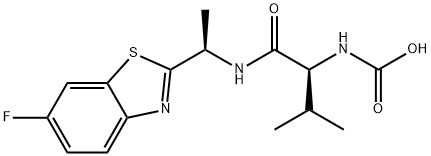
ChEBI: A carboxamide resulting from the formal condensation of the carboxy group of L-valine with (1R)-1-(6-fluoro-1,3-benzothiazol-2-yl)ethylamine and replacement of one of the hydrogens attached to the alpha-am
no group by a carboxy group. It is the active form of the fungicide benthiavalicarb isopropyl (in which the carbamic acid group has been converted to the corresponding isopropyl ester).
Production Methods
Benthiavalicarb is commercially synthesised through a multi-step process that constructs its valinamide carbamate fungicidal structure. The synthesis begins with the preparation of a fluorinated benzothiazole intermediate, which is then coupled with a valine-derived amine to form a urea linkage. This intermediate is further reacted with isopropyl chloroformate to introduce the isopropyl ester group, yielding benthiavalicarb-isopropyl. The process requires precise control of stereochemistry, as the compound exists as a mixture of R-L and S-L isomers.
Origin
Benthiavalicarb has been developed by Kumiai Chemicals Industry for treatment of tomatoes and potato late blight.
Mechanism of action
Protective and curative action with residual effects, inhibits phospholipid biosynthesis