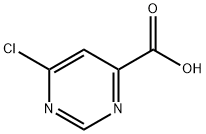
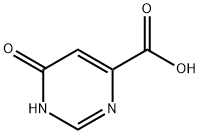
General procedure for the synthesis of 6-chloropyrimidine-4-carboxylic acid from 6-hydroxy-4-pyrimidinecarboxylic acid: 2 g of 6-hydroxy-4-pyrimidinecarboxylic acid was dissolved in 30 mL of ethyl acetate, and oxalyl chloride (3.75 mL, 3 eq., 0.043 mol) was slowly added, followed by the addition of a few drops of N,N-dimethylformamide (gas was observed to escape). The reaction mixture was heated to reflux at 75 °C for 3 h, subsequently cooled to room temperature and allowed to stand overnight. Upon completion of the reaction, the solvent was removed by distillation under reduced pressure to give a black solid product in quantitative yield. The resulting solid was to be stored under nitrogen protection at 4 °C.1H NMR analysis showed the product to be a mixture of 6-chloropyrimidine-4-carboxylic acid and its corresponding chloride derivatives (unstable at room temperature).1H NMR (d6-DMSO) data were as follows: 9.28 (s, 1H), 8.18 (s, 1H) for 6-chloropyrimidine-4-carboxylic acid; 8.45 (s, 1H), 8.45 (s, 1H), 8.93 (s, 1H), 8.45 (s, 1H), 8.45 (s, 1H), 8.45 (s, 1H), 6.93 (s, 1H) and 8.45 (s, 1H). 6.93 (s, 1H) for the signals of the chloride derivatives.