Chemical Properties
White Solid
Uses
A labelled metabolite of Oxcarbazepine
Uses
A metabolite of Oxcarbazepine
Definition
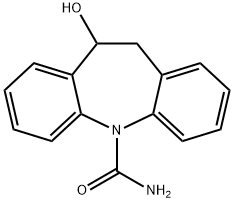
ChEBI: A dibenzoazepine that is 5H-dibenzo[b,f]azepine, reduced across the C-10,11 positions and carrying a carbamoyl substituent at the azepine nitrogen and a hydroxy function at C-10. A voltage-gated sodium channel b
ocker with anticonvulsant and mood-stabilizing effects, it is related to oxcarbazepine and is an active metabolite of oxcarbazepine.
Uses
?10,11-dihydro-10-hydroxy Carbamazepinee is the active metabolite of oxcarbazepine . Oxcarbazepine is rapidly and almost completely converted to 10,11-dihydro-10-hydroxycarbamazepine, which then demonstrates anticonvulsant efficacy by modulating several ion channels and receptors. ?10,11-dihydro-10-hydroxy Carbamazepine is reported to inhibit both voltage-gated Na+ and Ca2+ channels, to potentiate voltage-gated K+ channels, to antagonize adenosine A1 receptors, to increase dopaminergic transmission, and to inhibit glutamate release.
Synthesis
Step-2: Synthesis of compound 3
1aH-dibenzo[b,f]epoxyvinyl[2,3-d]azepine-6(10bH)-carboxamide (5.03 g, 20 mmol) was dissolved in a solvent mixture of methanol (100 ml), dichloromethane (50 ml) and water (5 ml) at room temperature and protected by nitrogen. Ammonium formate (3.78 g, 60 mmol) and 10% palladium carbon catalyst (540 mg, 0.51 mmol Pd) were subsequently added. The reaction mixture was stirred for 1 h at room temperature and then filtered through diatomaceous earth to recover the catalyst. The filter cake was washed with dichloromethane (20 ml) and the combined filtrates were separated and the organic phase was dried with anhydrous sodium sulfate. After filtration, the solvent was evaporated by rotary evaporator at 40°C and absorber pressure to give the crude product 3. The crude product was purified by crystallization from ethyl acetate (20 ml) to give white crystalline 10-hydroxy-10,11-dihydro-5H-dibenzo[b,f]azepine-5-carboxamide (4.7 g, 93% yield).
in vivo
Eslicarbazepine acetate (ESL) is an oral pro-drug that is rapidly and extensively metabolized by the liver via a hydrolytic first-pass metabolism into S-Licarbazepine, the biologically active drug. The plasma level of the prodrug remains below quantification[1].
ESL is a potent antiepileptic agent with a spectrum of action essentially limited to partial-onset and generalized tonic-clonic seizures. Its main mechanism of action is by blocking the voltage-gated sodium channel. ESL works by blocking the voltage-gated sodium channel, which play an essential role in the generation and propagation of the epileptic discharge. ESL is well absorbed after oral administration with a bio-availability about 16% higher than that observed after an equivalent dose of Oxcarbazepine (OXC)[1].
References
[1] Patent: WO2013/167985, 2013, A1. Location in patent: Paragraph 00102; 00103
[2] Patent: US2016/122332, 2016, A1. Location in patent: Paragraph 0123-0124
[3] Patent: WO2006/75925, 2006, A2. Location in patent: Page/Page column 9-10
[4] Bioorganic and Medicinal Chemistry, 2014, vol. 22, # 3, p. 1077 - 1088

![1A,10B-DIHYDRO-6H-DIBENZO[B,F]OXIRENO[D]AZEPINE-6-CARBOXAMIDE](/CAS/GIF/36507-30-9.gif)
