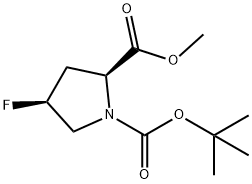
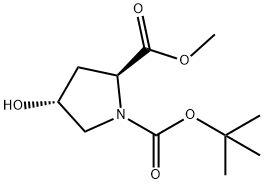
General procedure for the synthesis of N-Boc-trans-4-hydroxy-L-proline methyl ester from N-Boc-trans-4-hydroxy-L-proline methyl ester: To a solution of N-Boc-trans-4-hydroxy-L-proline methyl ester (11 g, 44.84 mmol) in dichloromethane (200 mL) was added dropwise at -78 °C a solution of diethylamino sulfur trifluoride ( Et2NSF3, 8.85 mL, 67.3 mmol). After the dropwise addition was completed, the reaction mixture was continued to stir at -78°C for 2 hours, followed by slow warming to room temperature and stirring for 19 hours. Upon completion of the reaction, the reaction was quenched with aqueous ammonium chloride (100 mL). The reaction mixture was extracted with dichloromethane (100 mL x 3). The organic layers were combined, dried with anhydrous sodium sulfate and concentrated under reduced pressure. The residue was purified by silica gel column chromatography with petroleum ether/ethyl acetate (v/v=20/1) as eluent to afford N-tert-butoxycarbonyl-cis-4-fluoro-L-proline methyl ester as a light yellow solid (5.0 g, 70% yield). The structure of the compound was confirmed by the following spectral data: mass spectrum (ESI positive ion mode) m/z: 248.26 [M+H]+; NMR hydrogen spectrum (400 MHz, CDCl3) δ (ppm): 5.26 and 5.13 (double peaks, 1H), 4.55-4.41 (multiple peaks, 1H), 3.88-3.74 (multiple peaks, 1H), and 3.73 (single peak, 3H), 3.64-3.58 (multiple peaks, 1H), 2.52-2.44 (multiple peaks, 1H), 2.40-2.32 (multiple peaks, 1H), 1.42-1.47 (double peaks, 9H, J=20Hz).