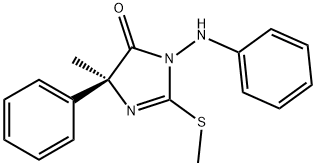
Definition
ChEBI: A member of the class of imidazolones that is 3,5-dihydroimidazol-4-one substituted at position 2 by a methylthiogroup, at position 3 by an anilino group and at position 5 by phenyl and methyl groups (the S-enantiomer). A fungicide effecti
e against Oomycete diseases such as downy mildew and certain leaf spot diseases.
Hazard
Moderately toxic by ingestion and skin contact. Low toxicity by inhalation.
Description
Fenamidone (13; RPA 407213; (S)-5-methyl-2-methylthio-
5-phenyl-3-phenylamino-3,4-dihydroimidazol-4-one) is a complex III inhibitor
that does not derive from the strobilurins but rather
belongs to the imidazolinone chemical class. Fenamidone is a white woolly powder, with the
following characteristics: mp = 137 ?C; water solubility =
7.8 mg/L; logP = 2.8, and vp = 3.4×10?7 Pa. It was
first described by Mercer et al. (39) in 1998. Only the
S-enantiomer shows antifungal activity, thus offering a
reduction in application rates over the racemic mixture.
Chemical Properties
The pure product is a white, wooly powder without a typical odor. Relative density: 1.288. Vapor pressure: 3.4×10⁻⁴ mPa (25°C), distribution coefficient: Kow lgP: 2.8 (20°C), Henry constant: 0.5×10⁻⁵ Pa m??/mol (20°C). Solubility in water: 7.8 mg/L (20°C). Solubility in organic solvents (20°C, g/L): acetone: 250, acetonitrile: 86.1, dichloromethane: 330, methanol: 43, n-octanol: 9.7.
Production Methods
The commercial production of fenamidone involves a complex multi-step chemical synthesis. One key method includes the reaction of methyl (2S)-2-phenyl-2-(isothiocyanato)propionate with phenylhydrazine in anhydrous tetrahydrofuran under an inert argon atmosphere, followed by cooling and further processing to yield the active compound (+)-(4S)-4-methyl-2-methylthio-4-phenyl-1-phenylamino-2-imidazolin-5-one.
Mechanism of action
Protective and curative action. Respiration inhibitor (QoL fungicide).
Toxicity evaluation
Fenamidone has an acute oral LD50 > 5,000 and an
acute dermal LD50 > 2,000 mg/kg in rats. Fenamidone is
not a skin or eye irritant, is negative in the Ames test, and
is nonteratogenic. It shows low toxicity to birds in acute
and dietary studies but has a 96-h fish LC50 of 0.74 mg/L.