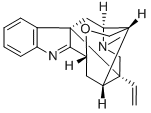
Description
The Chinese drug 'Kou-wen', said to be derived from Gelsemium elegans Benth.,
is stated to contain this alkaloid which forms rhombic prisms from Me2 CO. It
has [α]23D - 265° (EtOH) and forms a crystalline hydrochloride, m.p. 255°C
(dec.) and a hydrobromide, m.p. 269°C (dec.).
Chemical Properties
It is soluble in organic solvents such as acetone, chloroform, ether, and benzene, but poorly soluble in water. It is derived from the Gelsemium elegans (Gardn. et Champ.) Benth, a plant of the Cucurbitaceae family.
Uses
Koumine is known to attenuate the lipopolysaccharide-stimulated inflammation in RAW264.7 macrophages.
in vivo
Koumine is less toxic, with the median lethal dose (LD50) of 300.0 mg/kg on Wistar rats. Koumine (0.6, 3, or 15 mg/kg/per, p.o.) exhibits antirheumatic properties in rats with adjuvant-induced arthritis (AIA) and collagen-induced arthritis (CIA)[2].
Koumine inhibits the increase in cytokines in joint tissue and TNF-α level in serum at 15 mg/kg, and suppresses the increase in the serum level of IL-1β at 3 and 15 mg/kg[2].
Koumine (0.28, 7 mg/kg, s.c.) significantly reduces neuropathic pain after nerve injury. Koumine suppresses the increased Iba-1 protein level[3].
References
Chou, Pak, Hou., Chin. 1. Physiol., 5, 345 (1931)
Chou, Wang, Chen., ibid, 8,40 (1934)
Chi, Kao, Huang., 1. Amer. Chem. Soc., 60, 1723 (1938)