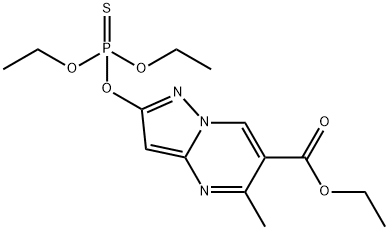
Chemical Properties
The pure product is colorless crystals. MPa is 51-53°C, relative density is 1.348 (25°C), vapor pressure is >0.133×10⁻³ Pa (20°C), 0.221×10⁻³ Pa (50°C). Solubility at 20°C: acetone 121.2%, toluene >98%, ethyl acetate 89.8%, ethanol 9.5%, n-hexane 1.1%, water 0.42% (0.03%). It is also soluble in organic solvents such as benzene, xylene, carbon tetrachloride, and trichloroethylene. It readily decomposes under acidic and alkaline conditions, but will not decompose significantly when stored in dry conditions for two years.
Uses
Pyrazophos is a systemic fungicide that provides both protective
and curative control of various fungal diseases such as powdery mildew
(Podosphaera) on apples, stone fruits, bush fruits and strawberries,
Erysiphe in cucurbits and tomatoes, Uncinula on vines and leaf blotch
(Rhynchosporium) in cereals.
Definition
ChEBI: A member of the class of pyrazolopyrimidines that is the ethyl ester of 2-[(diethoxyphosphorothioyl)oxy]-5-methylpyrazolo[1,5-a]pyrimidine-6-carboxylic acid. A fungicide used to control Erysiphe, Helminthosporium and
ital>Rhynchospium in cereals.
Production Methods
Pyrazophos is commercially produced by reacting O,O-diethyl phosphorochloridothioate with 2-hydroxy-5-methylpyrazole-3-carboxylate ethyl ester (prepared from ethyl acetoacetate and hydrazine followed by selective oxidation and esterification) in the presence of triethylamine or potassium carbonate in acetone or toluene, forming the phosphorothioate ester linkage. The crude product undergoes neutralisation, aqueous washing, and vacuum distillation to yield pyrazophos.
Mechanism of action
Systemic with protective and curative action. Phospholipid biosynthesis inhibitor.
Metabolic pathway
Limited information is available to describe the degradation and metabolic
fate of pyrazophos. Hydrolytic cleavage of the P-O-pyrazolopyrimidine
linkage is the primary metabolic pathway. Oxidative
desulfuration of pyrazophos to pyrazophos-oxon is only a minor
pathway, observed in the plant metabolism study (Scheme 1).
Metabolism
Its mode of action is believed to be the inhibition of
melanin biosynthesis and the development of appressoria
by fungal conidia. Formulation is available as emulsifiable
concentrate (EC: 30%). Application rates on Oidium spp.
are in the range of 15–30 g a.i./hl.
Degradation
Pyrazophos (1) is hydrolysed in acidic or alkaline solution (PM).