Chemical Properties
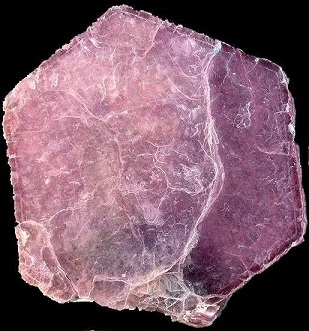
Lepidolite is named after the Greek word Lepidos, which means "scale". This is due to the typical formation of the mineral in scale-like clusters. Lepidolite contains between 1.23% to 5.90% lithium oxide and has a monoclinic crystal system with dimensions a=5.3, b=9.2, c=10.2, and β=100°. The crystal symmetry is m or 2/m, with pseudo-hexagonal plates forming fine scale-like clusters. Its attractive light purple color is combined with a glass luster, a hardness of 2-3, and a relative density of 2.8-2.9. There are over 150 minerals containing lithium, but only 30 of these are independent lithium minerals. The most important of these minerals is spodumene, followed by lepidolite.
Uses
Lepidolite is used as a raw material for glass. In ceramics, it acts as a flux. Lithium is the lightest metal, with a specific gravity of 0.534. It can produce lithium-6, needed for thermonuclear weapons, and is an important fuel for hydrogen bombs, rockets, nuclear submarines, and new jet aircraft. Lithium can absorb neutrons, serving as a control rod in nuclear reactors. Militarily, it is used as a red luminescent agent in signal flares and illumination flares, and as a thick lubricant in aircraft. In metallurgy, lithium is used to make lightweight alloys and as a purifying agent for metal products.
Agricultural Uses
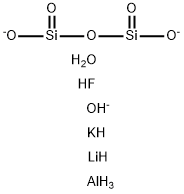
Lepidolite, a variety of mica, is a fluorosilicate of
potassium, lithium and aluminum found in pegmatites.
Generally, rubidium occurs as an impurity.

 ;
;