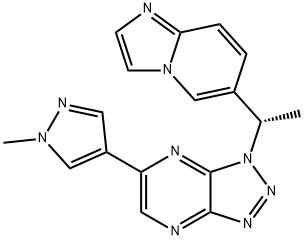
The synthesis of savolitinib started with 6-amino-3-carboxypyridine (20.1), which was treated with chloroacetaldehyde to generate the imidazopyridine 20.2. The carboxylic acid was converted to the Weinreb amide 20.3 and treated with methylmagnesium bromide to give the methyl ketone 20.4. The ketone was converted to the chiral amine 20.5 using a commercially available aminotransferase with the cofactors pyridoxal phosphate and isopropylamine as a nitrogen source. After process workup, the amine was isolated as the dihydrochloride salt (20.5). The free base was obtained by treatment with alkaline conditions, which was subsequently reacted with commercially available 3,5-dibromopyrazin-2-amine (20.6) to give the secondary amine 20.7. Next, nitrosyl ion formation and cyclization gave the 1,2,3-triazole 20.8. Finally, Suzuki coupling with 20.9 completed the construction of savolitinib (20). The boronic acid ester 20.9 was obtained from 4-bromo-1-methyl-1H-pyrazole by lithium-halogen exchange and workup with triisopropylborate quenching.