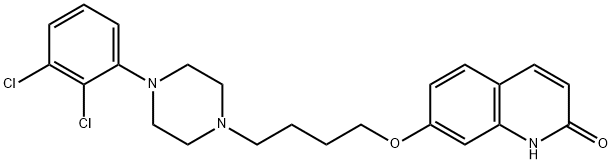
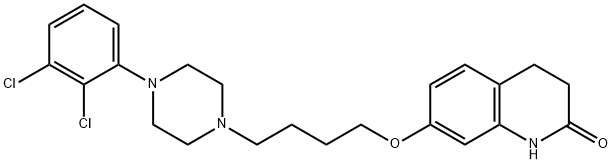
The general procedure for the synthesis of 7-[4-[4-(4-(2,3-dichlorophenyl)piperazin-1-yl)butoxy]-3,4-dihydroquinolin-2(1H)-ones from 7-(4-(4-(4-(2,3-dichlorophenyl)-1-piperazinyl)butoxy)-2(1H)-quinolinone was as follows:
Example 1: Large-scale synthesis of dehydroaripiprazole [7-(4-(4-(2,3-dichlorophenyl)piperazin-1-yl)butoxy)quinolin-2(1H)-one] (Compound 1; Formula VI) Aripiprazole (Formula VIA)
1. 15 g (0.03 mol) of 7-(4-(4-(4-(2,3-dichlorophenyl)piperazin-1-yl)butoxy)-3,4-dihydroquinolin-2(1H)-one was dissolved in 360 mL of anhydrous tetrahydrofuran to form a clarified solution.
2. 12 mL (0.16 mol) of trifluoroacetic acid was added to the solution.
3. 24.3 g (0.11 mol) of 1,2-dichloro-4,5-dicyanoquinone was added and the mixture was stirred at room temperature under a nitrogen atmosphere.
4. After the reaction was stirred for 40 minutes, TLC assay showed complete consumption of the raw material.
5. 1.5 L of water was added and then the reaction mixture was alkalized to pH 12 with 50% NaOH aqueous solution.
6. The reaction mixture was extracted with dichloromethane (3 x 300 mL), the organic phases were combined and dried with MgSO4.
7. The crude product was purified by column chromatography using silica as stationary phase and dichloromethane to 10% methanol/dichloromethane as eluent. 8. The product was purified by 2-propanolysis.
8. The product was further purified by recrystallization from 2-propanol to give 13.7 g (92%) of off-white solid target product.
Product characterization:
1H-NMR (400 MHz, CDCl3) δ 12.33 (1H, br s), 7.72 (1H, d), 7.42 (1H, d), 7.16-7.11 (2H, m), 6.98-6.93 (1H, dd), 6.83-6.79 (2H, m), 6.53 (1H, d), 4.10 (2H, t), 3.09 (4H, br), 4.10 (2H, t), 4.10 (2H, t). 3.09 (4H, br s), 2.67 (4H, br s), 2.52 (2H, t), 1.93-1.70 (4H, m).
LCMS (acidic method) [M + H]+ 446.02, rt 14.246 min.