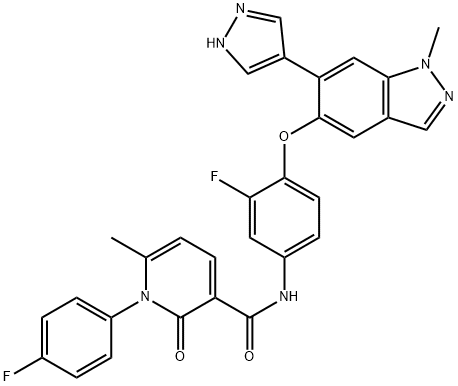
Description
MET is a tyrosine kinase that leads to downstream activation of several pathways
including RAS and MAPK.?As a result, it is quite possible that MET inhibition can
be active in RAS mutant tumors and maybe associated with EGFR resistance in
NSCLC.?Two MET inhibitors, tivantinib and onartuzumab, have been examined in
KRAS mutant NSCLC with others in clinical trials at this time.
Uses
LY2801653(Merestinib), a c-MET inhibitor developed by Lilly, has shown promising therapeutic effects in many solid tumors by targeting c-MET/HGFR and is used in clinical trials to treat a variety of oncolytic indications.
Mechanism of action
LY2801653(Merestinib) inhibited phosphorylation of eIF4E in MV4-11, MM6 and AML-PT cells, blocked the cell cycle in the G0/G1 phase by decreasing the expression of cyclin A2 and cyclin B1, arrested colony formation, induced apoptosis in MV4-11 cells and exhibited antileukemic properties in vivo.
Clinical Use
Preclinical testing also has shown merestinib to inhibit several other receptor tyrosine oncokinases including MST1R, FLT3, AXL, MERTK, TEK, ROS1, and NTRK1/2/3.
References
[1] yan s b et al. , ly2801653 is an orally bioavailable multi-kinase inhibitor with potent activity against met, mst1r, and other oncoproteins, and displays anti-tumor activities in mouse xenograft models. invest new drugs. 2012, 31: 833-844.