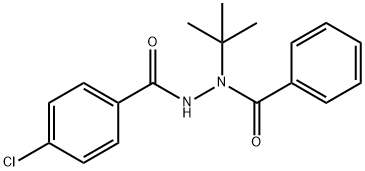
Description
Halofenozide is a soil insecticide. It has a moderate aqueous solubility and, based on its chemical properties, it may have a tendency to leach to groundwater. It can be persistent in soil systems and, under certain conditions, may also persist in aquatic systems. Whilst it has a relatively low mammalian toxicity there is some concern regarding its potential to bioaccumulate. It is moderately toxic to many aquatic species, honeybees and earthworms but is only slightly toxic to birds.
Uses
Halofenozide is a dibenzoylhydrazine based pesticide. Halofenozide is an ecdysteroid agonist used as white grub control. Halofenozide functions by interfering with the normal growth and development in insects.
Uses
Halofenozide is a dibenzoylhydrazine based pesticide. Halofenozide is an ecdysteroid agonist used as white grub control. Halofenozide functions by interfering with the normal growth and development in
insects.
Definition
ChEBI: Halofenozide is a bisacylhydrazine insecticide and a member of monochlorobenzenes. It is functionally related to a N'-benzoyl-N-(tert-butyl)benzohydrazide.
Production Methods
Halofenazide is synthesised through a multi-step organic process that centres on constructing its hydrazide core and attaching functional aryl groups. The synthesis typically begins with the preparation of a substituted benzoyl chloride, which is reacted with a hydrazine derivative to form the key diacylhydrazine backbone. This intermediate is then functionalised with alkyl or acyloxy substituents via esterification or etherification reactions to enhance bioactivity and stability. In some routes, parallel synthesis techniques are used to optimize side-chain variations. The final compound is purified through recrystallisation or chromatography to yield high-purity halofenazide.
Mechanism of action
Systemic with stomach action. Disrupts the hormonal systems that control insect growth and moulting. Ecdysone receptor agonist
in vivo
After topical application of Halofenozide (RH-0345; 5 and 10 μg) on adult females, the highest dose (10 μg) reduces significantly the reproductive parameters scored: namely the oviposition period, the fecundity and the egg viability[1].
Halofenozide at the two doses tested (5 and 10 μg) causes smaller eggs with a decrease in length, width and volume[1].
| Animal Model: | Newly emerged (0-day-old) adult females of T. molitor[1] |
| Dosage: | 5 and 10 μg |
| Administration: | Topically applied |
| Result: | Caused smaller eggs with a decrease in length, width and volume at the two doses tested (5 and 10 μg) .
|
Pesticide Type
Insecticide; Insect Growth Regulator