Product Number: P059057
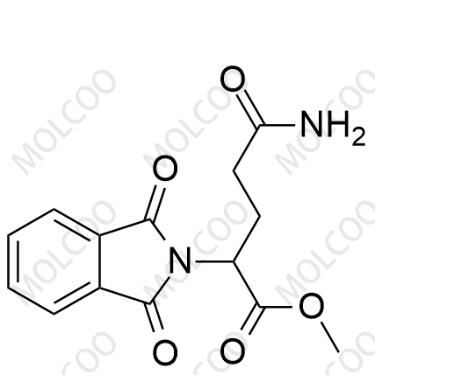
English Name: Pomalidomide Impurity 57
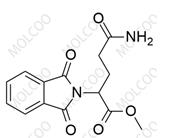
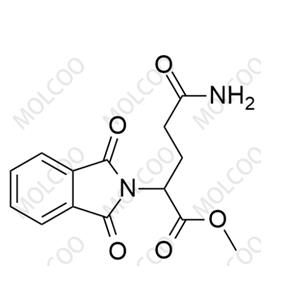
English Alias: methyl 5-amino-4-(1,3-dioxoisoindolin-2-yl)-5-oxopentanoate
CAS Number: 19143-28-3
Molecular Formula: C₁₄H₁₄N₂O₅
Molecular Weight: 290.27
As an impurity reference standard for pomalidomide, this compound has the following advantages:
Well-defined structure and high stability, enabling precise analysis of side reaction mechanisms during pomalidomide synthesis, such as esterification, amino group introduction, and isoindoline ring construction, to optimize processes and reduce impurity generation;
The structure containing ester, amino, and isoindolinedione groups provides a standard substance for detection methods like HPLC and LC-MS, improving the separation and quantitative accuracy of complex-structured impurities;
Helps study the impact of ester and amino groups on drug stability and toxicological properties to provide a scientific basis for impurity control strategies.
Drug Development: Used as an impurity reference standard to identify and quantify Impurity 57 in pomalidomide preparations, evaluating the purity of APIs and formulations;
Quality Control: Acting as a standard substance to validate the sensitivity and specificity of detection methods (e.g., HPLC, LC-MS), ensuring impurity content meets pharmacopoeia requirements during production;
Stability Studies: Investigating the degradation behavior of this impurity under light, high temperature, and high humidity conditions to evaluate its impact on pomalidomide formulation stability.
Pomalidomide is an immunomodulatory agent for treating multiple myeloma. In its synthesis, incomplete esterification reactions or raw material residues easily generate impurities such as methyl 5-amino-4-(1,3-dioxoisoindolin-2-yl)-5-oxopentanoate. Such impurities may affect drug safety and effectiveness, making research on them a key part of pomalidomide quality control.
Current research focuses on:
Detection Method Optimization: Establishing trace detection methods (detection limits reach ppb level) using ultra-high-performance liquid chromatography-tandem mass spectrometry (UPLC-MS/MS);
Synthesis Process Improvement: Reducing impurity generation by optimizing reaction temperature and catalyst types;
Toxicological Evaluation: Studying the potential toxicity of this impurity through in vitro cell experiments and animal models;
Crystal Form Research: Analyzing the impact of impurity crystal forms on drug formulation stability to improve the quality control system.



 China
China