Product Number: N003001
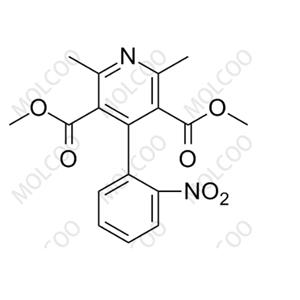
English Name: Nifedipine EP Impurity A
English Alias: dimethyl 2,6-dimethyl-4-(2-nitrophenyl)pyridine-3,5-dicarboxylate
CAS Number: 67035-22-7
Molecular Formula: C₁₇H₁₆N₂O₆
Molecular Weight: 344.32
As a European Pharmacopoeia (EP) standard impurity of nifedipine, the research advantages of this compound include:
Serving as an EP-compliant reference standard for direct use in quality testing of nifedipine APIs and formulations, ensuring consistency with international pharmacopoeia standards;
Helping to analyze the side reaction mechanism of pyridine ring construction in nifedipine synthesis to optimize processes and reduce the formation of ortho-nitrophenyl-substituted impurities;
Assisting in evaluating the impact of ortho-nitro structures on drug stability to provide a basis for establishing storage conditions and shelf life.
Quality Control: Used as an EP standard impurity reference for system suitability tests in HPLC and other detection methods to verify whether the content of this impurity in nifedipine meets EP standards;
Drug Development: In generic drug research, used to compare the impurity profile of the original drug to ensure quality consistency between the generic and original drug;
Process Optimization: Guiding the optimization of nitration and pyridine ring condensation reaction conditions in the synthesis route to reduce impurity generation through impurity content analysis.
Nifedipine is a commonly used calcium channel blocker in clinical practice for the treatment of hypertension and angina. If the nitro substitution position or pyridine ring condensation reaction is not properly controlled during its synthesis, ortho-nitrophenyl-substituted impurities (such as Impurity A) are easily generated. The European Pharmacopoeia (EP) has clear limits for this impurity, making research on it a necessary part of international quality control for nifedipine.
Current research focuses on:
Detection Method Optimization: Using EP-recommended HPLC-UV methods or LC-MS combined techniques to improve the detection sensitivity and specificity of this impurity;
Synthesis Process Improvement: Reducing the generation of ortho-nitrophenyl derivatives by adjusting the reagent ratio and temperature of the nitration reaction;
Stability Studies: Investigating the degradation behavior of this impurity under light, high temperature, and high humidity conditions to evaluate its impact on nifedipine formulation stability;
Toxicological Evaluation: Studying the potential genotoxicity of ortho-nitro structures through in vitro cell experiments to provide data support for establishing safe limits.




 China
China