Product Number: E034009
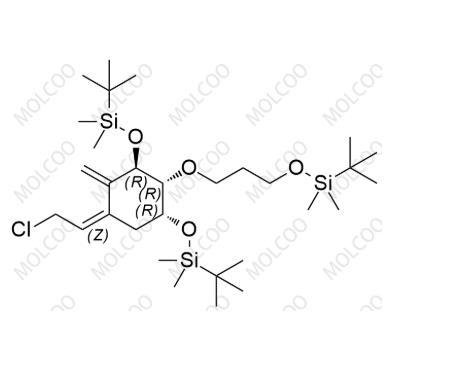
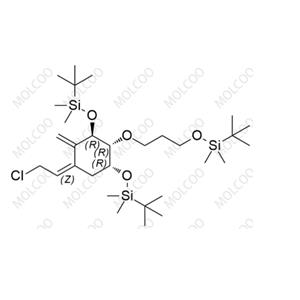
English Name: Eldecalcitol Impurity 9
English Alias: (((1R,2R,3R,Z)-2-(3-((tert-butyldimethylsilyl)oxy)propoxy)-5-(2-chloroethylidene)-4-methylenecyclohexane-1,3-diyl)bis(oxy))bis(tert-butyldimethylsilane)
CAS Number: 200636-50-6
Molecular Formula: C₃₀H₆₁ClO₄Si₃
Molecular Weight: 605.51
As an impurity of Eldecalcitol, this compound has the following advantages:
Well-defined and distinct structure: Contains three tert-butyldimethylsilyl (TBS) groups, 2-chloroethylidene side chain, methylenecyclohexane, and propoxy moieties. Strong hydrophobicity from silyl groups and electronegativity of chlorine create significant polarity differences from eldecalcitol, enabling accurate identification via GC or normal-phase HPLC as a specific impurity marker;
High stability and traceability: TBS protection and chloro-substitution ensure extreme stability under non-acidic conditions. As an intermediate from incomplete desilylation, chloro-reduction, or blocked cyclization in eldecalcitol synthesis, it directly reflects efficiency of key steps, improving process tracing accuracy;
High detection sensitivity: UV absorption (240-260nm) from (Z)-chloroalkene conjugation, combined with chlorine isotope pattern (³⁵Cl/³⁷Cl) and silicon-specific mass responses (e.g., Si(CH₃)₂C(CH₃)₃ fragments), enables trace analysis (ppm level) via GC-MS or LC-MS, compatible with silyl-protected/halogenated vitamin D precursor systems.
Pharmaceutical quality control: Used as an impurity reference standard to quantify Eldecalcitol Impurity 9 in APIs, ensuring residual chlorinated/silylated intermediates meet quality standards post-desilylation/reduction/cyclization;
Synthesis optimization: Optimizing TBS deprotection (fluoride dosage), chloroethylidene reduction (catalyst selectivity), and cyclization by monitoring impurity levels to enhance dechlorination and steroid ring formation efficiency;
Intermediate purity assessment: Evaluating purity of key chloroalkene intermediates in eldecalcitol synthesis to support specificity of downstream dechlorination/ring closure.
Eldecalcitol, an active vitamin D₃ analog, requires silyl protection, chloroalkene coupling, dechlorination, and cyclization for steroid synthesis. Incomplete TBS deprotection, blocked chloro-reduction, or failed cyclization may generate fully silylated/chlorinated derivatives like Eldecalcitol Impurity 9. Its chloro-substitution risks interfering with reduction steps and lack of bioactivity, making control critical for eldecalcitol quality assurance.
Current research focuses on:
Analytical method validation: Developing GC-MS assays with SIM mode for chlorine/silicon fragments, achieving 0.5 ppm detection limits for baseline separation of impurity and intermediates;
Dechlorination kinetics: Studying impurity formation under varying hydrogenation conditions to clarify selective 2-chloroethylidene reduction mechanisms;
Process refinement: Controlling impurity levels below 0.1% via optimized cyclization catalysts to enhance dechlorination and ring closure efficiency;
Structural characterization: Using 2D-NMR and X-ray diffraction to confirm (1R,2R,3R) configuration and (Z)-chloroalkene geometry, supporting structural differentiation from eldecalcitol precursors.




 China
China