Product Number: E034006
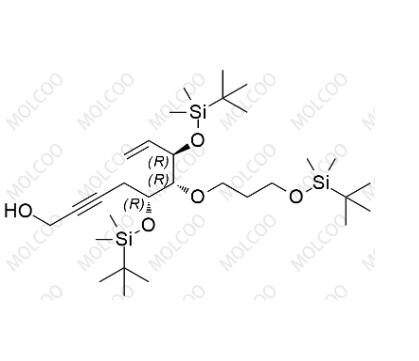
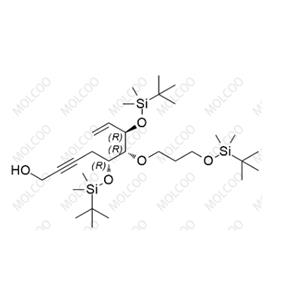
English Name: Eldecalcitol Impurity 6
English Alias: (5R,6R,7R)-5,7-bis((tert-butyldimethylsilyl)oxy)-6-(3-((tert-butyldimethylsilyl)oxy)propoxy)non-8-en-2-yn-1-ol
CAS Number: 2950969-02-3
Molecular Formula: C₃₀H₆₂O₅Si₃
Molecular Weight: 587.07
As an impurity of Eldecalcitol, this compound has the following advantages:
Well-defined with prominent protecting group features: Contains three tert-butyldimethylsilyl (TBS) groups, enyne unsaturation, and propoxy side chain, differing from eldecalcitol by retained full silyl protection and uncyclized steroid skeleton. Strong hydrophobicity from multiple silyl groups enables clear differentiation via GC or normal-phase HPLC as a specific impurity marker;
High stability and traceability: TBS-mediated hydroxyl protection ensures extreme stability under non-acidic conditions. As an intermediate from incomplete desilylation in eldecalcitol synthesis, it directly reflects deprotection efficiency, improving process tracing accuracy;
High detection sensitivity: UV absorption (220-240nm) from enyne conjugation, combined with silicon-specific mass responses (e.g., Si(CH₃)₂C(CH₃)₃ fragments), enables trace analysis (ppm level) via GC-MS or LC-MS, compatible with silyl-protected vitamin D precursor impurity systems.
Pharmaceutical quality control: Used as a reference standard to quantify Eldecalcitol Impurity 6 in APIs, ensuring residual silylated intermediates meet quality standards post-desilylation/cyclization;
Synthesis optimization: Optimizing TBS deprotection (fluoride dosage) and enyne cyclization by monitoring impurity levels to enhance steroid ring formation efficiency;
Intermediate purity assessment: Evaluating purity of key enyne intermediates in eldecalcitol synthesis to support specificity of downstream reactions.
Eldecalcitol, an active vitamin D₃ analog for osteoporosis, requires silyl protection, enyne coupling, and cyclization for steroid synthesis. Incomplete TBS deprotection or blocked enyne cyclization may generate fully silylated enyne derivatives like Eldecalcitol Impurity 6. Its interference with cyclization and lack of bioactivity make control critical for eldecalcitol quality assurance.
Current research focuses on:
Analytical method validation: Developing GC-MS assays with 5% phenyl methyl siloxane columns for baseline separation of impurity and intermediates, achieving 0.5 ppm detection limits;
Desilylation kinetics: Studying impurity formation under varying fluoride concentrations to clarify TBS cleavage mechanisms;
Cyclization refinement: Controlling impurity levels below 0.1% via optimized gold-catalyzed enyne cyclization to enhance API purity;
Stereochemical confirmation: Using ¹H/¹³C-NMR to verify (5R,6R,7R) configuration, supporting structural differentiation from eldecalcitol precursors.




 China
China