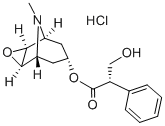
Hyoscine hydrochloride
- Product NameHyoscine hydrochloride
- CAS55-16-3
- MFC17H22ClNO4
- MW339.81
- EINECS200-225-6
- MOL File55-16-3.mol
Chemical Properties
| Melting point | 200° |
| Flash point | 77 °C |
| storage temp. | -20°C |
| solubility | H2O: 50 mg/mL |
| form | powder |
| color | white |
| optical activity | [α]25/D ~ 27°, c = 1 in H2O(lit.) |
| Water Solubility | H2O: 50mg/mL |
| BRN | 4168778 |
| InChI | 1S/C17H21NO4.ClH/c1-18-13-7-11(8-14(18)16-15(13)22-16)21-17(20)12(9-19)10-5-3-2-4-6-10;/h2-6,11-16,19H,7-9H2,1H3;1H/t11-,12-,13-,14+,15-,16+;/m1./s1 |
| InChIKey | KXPXJGYSEPEXMF-MOUKNHLCSA-N |
| SMILES | Cl.[H][C@]12C[C@H](C[C@]([H])(N1C)[C@]3([H])O[C@]23[H])OC(=O)[C@H](CO)c4ccccc4 |
| CAS DataBase Reference | 55-16-3(CAS DataBase Reference) |
Safety Information
| Hazard Codes | T+ |
| Risk Statements | 26/27/28 |
| Safety Statements | 25-45-36/37-28 |
| RIDADR | UN 1544 6.1/PG 3 |
| WGK Germany | 3 |
| RTECS | CY1634501 |
| F | 3-8 |
| Storage Class | 6.1A - Combustible acute toxic Cat. 1 and 2 very toxic hazardous materials |
| Hazard Classifications | Acute Tox. 1 Dermal Acute Tox. 2 Inhalation Acute Tox. 2 Oral Eye Dam. 1 Skin Sens. 1 |