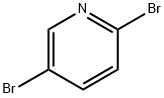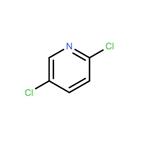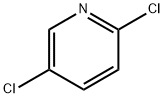
2,5-Dichloropyridine
- Product Name2,5-Dichloropyridine
- CAS16110-09-1
- MFC5H3Cl2N
- MW147.99
- EINECS240-278-2
- MOL File16110-09-1.mol
Chemical Properties
| Melting point | 59-62 °C (lit.) |
| Boiling point | 190-191 °C |
| Density | 1.5159 (rough estimate) |
| refractive index | 1.5500 (estimate) |
| Flash point | 112 °C |
| storage temp. | Inert atmosphere,Room Temperature |
| pka | -2.25±0.10(Predicted) |
| form | Crystalline Solid |
| color | White to slightly yellow |
| Water Solubility | insoluble |
| BRN | 108886 |
| InChI | InChI=1S/C5H3Cl2N/c6-4-1-2-5(7)8-3-4/h1-3H |
| InChIKey | GCTFDMFLLBCLPF-UHFFFAOYSA-N |
| SMILES | C1(Cl)=NC=C(Cl)C=C1 |
| CAS DataBase Reference | 16110-09-1(CAS DataBase Reference) |
Safety Information
| Hazard Codes | Xi,Xn |
| Risk Statements | 36/37/38-22 |
| Safety Statements | 26-37/39-36 |
| RIDADR | UN2811 |
| WGK Germany | 3 |
| RTECS | US8225000 |
| Hazard Note | Harmful |
| HazardClass | IRRITANT |
| HazardClass | 6.1 |
| HS Code | 29333990 |
| Storage Class | 11 - Combustible Solids |
| Hazard Classifications | Eye Irrit. 2 Skin Irrit. 2 STOT SE 3 |