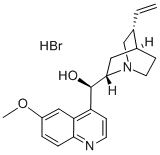
Quinidine hydrobromide is rapidly absorbed, with peak plasma concentrations 60-90 min after an oral dose. Other salts (gluconate, polygalacturonate) are more slowly absorbed, with lower peak concentrations[2].
Quinidine hydrobromide is approximately 70-90 % bound to plasma proteins. It undergoes hepatic oxidative metabolism to form an N-oxide, a 3-hydroxy form, an O-demethyl form and 2'-quinidinone[2].
Quinidine hydrobromide inhibits metabolism of amphetamine in rats. Quinidine hydrobromide pretreatment results in a significant decrease in the excretion of p-hydroxyamphetamine at 24 and 48 h to 7.2 and 24.1% of the vehicle-control levels, respectively, accompanied by a significant increase in amphetamine excretion between 24 and 48 h to 542% of the control[3].