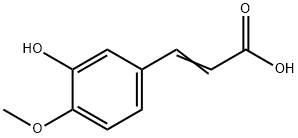
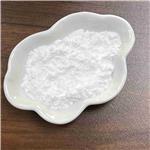
3-Hydroxy-4-methoxycinnamic acid, predominantly trans is available as white crystals. 3-Hydroxy-4-methoxycinnamic acid is isolated from the aerial part of Artemisia capillaris, Chinese medicinal plant. It is a component of chinese herbal medicine used for a pain killer and stomachic. It is an efficient acetylcholine inhibitor. 3-Hydroxy-4-methoxycinnamic acid is bioactive metabolite of Spilanthes acmella Murr. It increases the resistance of low-density lipoprotein (LDL) to oxidation.
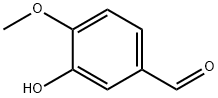
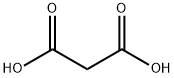
To a suspension of isovanillin (152 mg, 1.00 mmol) and malonic acid (416 mg, 4.00 mmol) in toluene (5 mL) was added triethylamine (0.70 mL, 5.00 mmol) and N,N-dimethylformamide dimethyl acetal (0.20 mL, 1.50 mmol). The reaction mixture was heated to reflux for 4 hours, subsequently cooled to room temperature and concentrated on a rotary evaporator. The residue was dissolved in 1 M NaOH solution (20 mL) and the resulting solution was washed with dichloromethane (3 x 20 mL). The aqueous phase was acidified to pH 1 by the addition of 3 M HCl. The milky precipitate formed was collected in a Hirsch funnel, washed with dilute hydrochloric acid and air dried. The precipitate was recrystallized by solvent recrystallization in a methanol-water mixture and dried in a vacuum desiccator using phosphorus pentoxide as a drying agent to give trans-3-hydroxy-4-methoxycinnamic acid (164 mg, 85% yield) as a cream-colored crystalline solid.1H NMR spectroscopic data were in agreement with those reported in the literature (McCorkindale, N.J.; McCulloch, A.W. Magrill, D.S.; Caddy, B.; Martin-Smith, M.; Smith, S.J.; Stenlake, J.B. Tetrahedron 1969, 25, 5475).
[1] Synthetic Communications, 1995, vol. 25, # 20, p. 3187 - 3197
[2] Chemical Communications, 1998, # 21, p. 2335 - 2336
[3] Tetrahedron, 2007, vol. 63, # 4, p. 960 - 965
[4] Tetrahedron Letters, 2012, vol. 53, # 20, p. 2537 - 2539
[5] Bioorganic and Medicinal Chemistry, 2014, vol. 22, # 9, p. 2707 - 2713