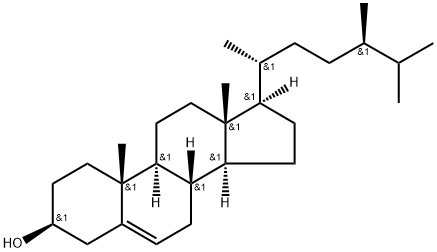
24α-methyl Cholesterol is a phytosterol found in vegetables, fruits, nuts, and seeds that competitively inhibits the absorption of intestinal cholesterol and decreases the transcription of genes important for cholesterol metabolism. The cholesterol lowering effects of phytosterols, such as 24α-methyl cholesterol, have been reported to be beneficial for lowering the incidence of atherosclerotic plaques. 24α-methyl Cholesterol can also act as an agonist at liver X receptors (LXR) and, through activation of LXR signaling, has been shown to suppress the proliferation of prostate and breast cancer cells.
A phytosterol, which may inhibit the intestinal absorption of cholesterol.
Campesterol may be used as a plant sterol to test its effect on the transcriptional activation of liver X receptor α (LXRA) in breast cancer cells. It may also be used as a sterol standard for calibration curve generation in liquid chromatography multiple reaction monitoring (LC-MRM) analysis.
ChEBI: Campesterol is a member of phytosterols, a 3beta-sterol, a 3beta-hydroxy-Delta(5)-steroid and a C28-steroid. It has a role as a mouse metabolite. It derives from a hydride of a campestane.
Campesterol is a plant sterol, which is an analog of cholesterol and a brassinosteroid (BR) precursor. The enzyme diminute/dwarf1 mediates the synthesis of campesterol from 24-methylenecholesterol. Campesterol possesses methyl group at C-24 position of the side chain in the cholesterol structure.
Campesterol is a phytosterol, primarily found in nuts, fruits, legumes and seeds. Though an analogue of cholesterol, it is poorly absorbed in humans and competitively inhibits the absorption of cholesterol. Campesterol decreases the transcription of genes involved in cholesterol metabolism in hepatocytes and enterocytes and has positive impact in treatment of cardiovascular disease.
Campesterol is recrystallised twice from hexane and once from Me2CO. The benzoyl derivative has m 158-160o [] D 23 -8.6o (CHCl3), and the acetyl derivative has m 137138o (EtOH) and [] D 23 -35.1o (c 2.9, CHCl3) [Fernholz & MacPhillamy J Am Chem Soc 6 3 1155 1941]. [Beilstein 6 III 2680.]
[1] MOHAMED FAWZY RAMADAN Hesham E S Rawya Zayed. Screening of bioactive lipids and radical scavenging potential of some solanaceae plants[J]. Food Chemistry, 2007, 103 3: Pages 885-890. DOI:
10.1016/j.foodchem.2006.09.040[2] JUNG-MIN CHOI. Identification of campesterol from Chrysanthemum coronarium L. and its antiangiogenic activities.[J]. Phytotherapy Research, 2007, 21 10: 954-959. DOI:
10.1002/ptr.2189[3] RANABIR MAJUMDER, MAHITOSH MANDAL* A Virtual Drug Discovery Screening Illuminates Campesterol as a Potent Estrogen Receptor Alpha Inhibitor in Breast Cancer[J]. Journal of Medicinal Chemistry, 2024, 67 12: 10321-10335. DOI:
10.1021/acs.jmedchem.4c00766[4] ALAN H.B. WU . Biological variation of β-sitosterol, campesterol, and lathosterol as cholesterol absorption and synthesis biomarkers[J]. Clinica Chimica Acta, 2014, 430: Pages 43-47. DOI:
10.1016/j.cca.2013.12.040