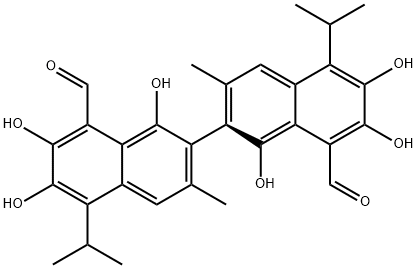
AT-101 (90141-22-3) is a small molecule mimic of the BH3 domain of cellular Bcl-2 inhibitors which interferes with the function of Bcl-2-family antiapoptotic proteins. AT-101 induces apoptosis in drug-resistant multiple myeloma cell lines. Apoptosis is activated by the mitochondrial pathway. Cell permeable.
AT-101 is a BH3 mimetic known to be a potent inhibitor of antiapoptotic Bcl-2 family members.
R-(-)-enantiomer of gossypol (Gossypol). Mimics the BH3 domains of Bcl-2, Bcl-XL and Mcl-1. Disrupts heterodimerization of Bcl-2 with proapoptotic family members. Induces apoptosis in vitro through activation of caspase-9; cytotoxic to multiple myeloma and drug-resistant cell lines. Delays onset of androgen-independent growth of VCaP prostate cancer xenografts in vivo .
AT101 [R-(-)-enantiomer of gossypol] is an orally available and well-tolerated natural BH3-mimetic that activates Bax and also induces mitochondrial Smac release. AT101 has shown anti-tumor activity as a single agent and in combination with standard anticancer drugs in a variety of tumor models. AT101 induced apoptosis in chemoresistant ovarian cancer cells.
[1] MICHAEL P. KLINE. R-(-)−gossypol (AT-101) activates programmed cell death in multiple myeloma cells[J]. Experimental hematology, 2008, 36 5: Pages 568-576. DOI:
10.1016/j.exphem.2008.01.003[2] KUMUDHA BALAKRISHNAN. AT-101 induces apoptosis in CLL B cells and overcomes stromal cell-mediated Mcl-1 induction and drug resistance.[J]. Blood, 2009: 149-153. DOI:
10.1182/blood-2008-02-138560