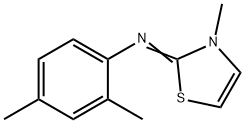
Cymiazol is an acaricide. It is moderately soluble in water and volatile. It does not tend to be persistent in soil systems but may be in some water systems. It is not susceptible to hydrolysis. It is moderately toxic to mammals and may bioaccumulate. It is an eye and skin irritant. It shows a moderate level of toxicity to birds, fish and honeybees.
Cymiazole is a pesticide residues in fruits and vegetables. An acaricide.
The production of cymiazol involves the synthesis of its core structure: an iminophenyl thiazolidine derivative. The process typically starts with the preparation of a 2,4-dimethylphenyl precursor, which is then reacted with a thiazole ring system through a condensation reaction to form the imine linkage. The final compound, N-(2,4-dimethylphenyl)-3-methyl-1,3-thiazol-2(3H)-imine, is purified and often converted into its hydrochloride salt to enhance solubility and stability for veterinary formulations.
Contact action. Acts on nervous system. Octopamine receptor agonist.
Acaricide; Insecticide; Veterinary substance